
Astra lost in space anime plot and themes aren't what you'd expect from the cover art. You see the bright colors and the cheerful protagonist Aries Spring with her heterochromatic eyes and you think you're in for a standard shonen adventure with some space camping. Then the glowing sphere shows up on McPa and teleports nine high schoolers thousands of light-years from home, and you realize this isn't a field trip gone wrong, it's an attempted mass murder orchestrated by their own parents.
The series aired in 2019, produced by Lerche with direction by Masaomi Ando, and it adapts Kenta Shinohara's manga that ran from 2016 to 2017. It covers the full story in twelve episodes, with the first and last episodes being double length to cram in all the revelations. The animation quality varies, the CGI for the ship Astra looks like something out of a PlayStation 2 cutscene, but the character work and the plotting are tight enough that you stop caring about the rubbery alien designs after episode three. Apparently, the manga won the Manga Taisho award in 2019, and the anime adaptation was recognized at the Seiun Sci-Fi Awards according to Wikipedia.
The Setup is Brutally Efficient
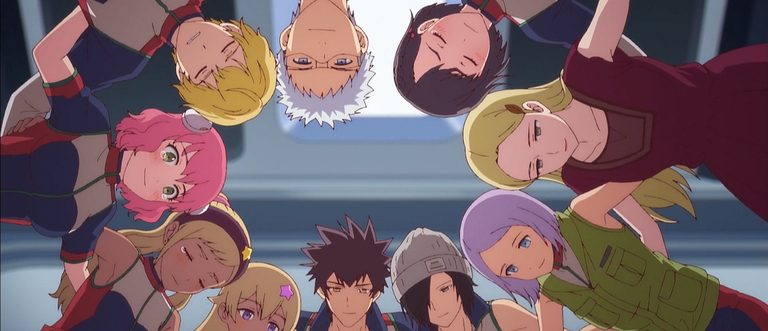
The year is 2063 and space travel is commercialized to the point where high schoolers can visit other planets for camping trips. Caird High School's Group B5 lands on McPa, which appears to be an uninhabited world with a breathable atmosphere. The group includes Kanata Hoshijima, the would-be astronaut who acts cheerful but carries guilt from a mountain climbing accident that killed his teacher. Aries Spring transfers in that day, literally bumping into Kanata at the spaceport in a meet-cute that feels generic until you realize it's plot critical later.
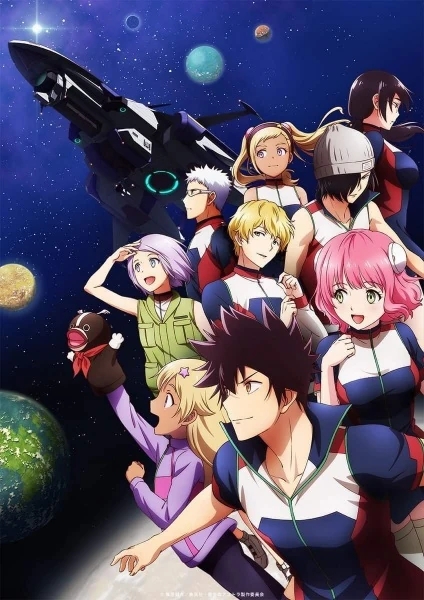
There's Zack Walker, the genius pilot with ice water in his veins, and Quitterie Raffaeli, the tsundere medic who argues with everyone. Her adopted sister Funicia comes along despite being elementary school age. Luca Esposito draws in his sketchbook and makes easy conversation, Ulgar Zweig scowls in the corner and reads books about journalism, Yunhua Lu tries to disappear into the background, and Charce Lacroix charms everyone with his cooking and botany knowledge.
The sphere appears during their first day of camping. It's a black orb with a golden ring that swallows them whole and drops them in orbit above an unknown ice planet. They have their helmets on by pure luck, which keeps them alive in the vacuum. Floating nearby is an abandoned spaceship, the B-5, which they rename the Astra. It's functional despite being over a hundred years old, stocked with food and water for a long haul. Kanata declares they'll fly it home, stopping at habitable planets along the way to resupply. That's the basic premise, but the execution gets dark fast. The Reddit rewatch threads from years later still analyze how efficiently this opening works.
Every Character is a Walking Secret
The show doesn't bother with filler episodes where they fight random space pirates. Every conflict ties back to who these kids are and why they were chosen. Kanata's leadership gets tested immediately when he has to perform a spacewalk to save Aries after her suit malfunctions. He claims he's just faking confidence, but his ability to stay calm under pressure keeps the crew alive when they crash on Vilavurs, a planet with low gravity and plants that act like trampolines.
Aries seems like the typical ditzy anime girl with pink hair, but she's got an eidetic memory that becomes the crew's most valuable asset. She notices details others miss, like the fact that the ship's logs don't match up with known history, or that certain crew members have habits that don't align with their backstories. Her memory becomes the key to unraveling the mystery of the traitor.
Zack and Quitterie have a childhood friendship that hints at deeper connections. Zack's father is a famous explorer, Quitterie's mother is a politician involved in the Genome Control Act. These details feel like background flavor until you realize they're directly related to the cloning plot. Funicia carries a hand puppet named Beego that she uses to communicate when she's scared, but the puppet also serves as a way for the writers to drop exposition without breaking character.
Luca draws constantly, documenting the alien life they encounter. He seems like the most well-adjusted member of the crew, which makes his reveal hit harder. Ulgar carries a gun he smuggled aboard, which is supposed to be impossible because firearms were outlawed in 1963 according to the history books. That's the first clue that something is wrong with the timeline. He plans to kill Marco Esposito, Luca's father, to avenge his brother who died under suspicious circumstances.
Yunhua's mother is a famous singer who crushed her daughter's self-esteem to prevent competition. Yunhua spends the first half of the series as dead weight, too scared to speak up or contribute, until a near-death experience on Shummoor forces her to find her voice. Charce is the last to show his hand, playing the perfect crewmate who knows exactly which plants are edible and how to cook them, but he's been lying about his origins from day one.
The Planets Serve the Plot
The crew visits five major planets on their way back to Earth, and each one serves as both a survival challenge and a character test. Vilavurs has the trampoline trees and low gravity that let the animators show off with physics-defying action sequences. They hunt turtle-dragons for food and learn to trust each other's skills.
Shummoor is a mushroom planet where the spores are toxic. The entire crew gets poisoned and Quitterie has to work with limited medical supplies to synthesize an antidote while Kanata and Yunhua hike to a specific location to find a rare plant. This arc forces Yunhua out of her shell and shows Quitterie's competence as a doctor despite her bratty exterior.
Arispade is the ocean world that looks like a tropical paradise until an underwater earthquake triggers a tsunami. They find another abandoned ship here with cryosleep pods, which is where they discover Paulina Levinskaya. She's from the original generation of space colonists, frozen for over a century, and her existence proves that the history everyone learned in school is a lie.
Icriss is the most dangerous, a tidally locked planet with extreme temperatures on either side and a narrow habitable zone. They crash land here and have to make repairs while dealing with the stress of knowing someone among them is a traitor. The environment is hostile, with storms and limited resources, and it forces confrontations between crew members who have been holding back their suspicions.
Galem is the final stop, a world of bioluminescent forests that feels almost magical compared to the harsh environments before it. By this point the crew has bonded into a functional family unit, so the planet serves more as a place for quiet conversations and revelations rather than survival action.
The Conspiracy Unfolds in Layers
The first mystery is who sabotaged the communications device. Zack finds evidence of deliberate damage, meaning one of the nine wanted to keep them isolated. The show throws red herrings at you, making Ulgar look suspicious with his gun and his secretive behavior, or suggesting Quitterie's family connections might make her the mole.
The truth is Charce, but he's not just a simple villain. He's a clone of the king of Vixia, raised to be loyal to the royal family above all else. His mission was to deliver Aries, who is a clone of Princess Seira, to the king so the original could have a young body to inhabit. He was supposed to kill the others after securing her. But spending months with the crew, eating meals together and saving each other's lives, breaks his programming.
That's the first layer. The second layer is the Genome Control Act, a law that requires universal genetic testing. This was passed to prevent illegal cloning, which had become common among the wealthy who wanted spare organs or eternal youth. The parents of the Astra's crew, all powerful or influential people, created these kids as replacement bodies. When the testing law passed, they needed to dispose of the evidence.
They hired an organization to teleport the kids into deep space where they'd die of starvation or accident, leaving no bodies to test back home. The sphere wasn't a random phenomenon, it was a targeted assassination tool. The parents didn't just abandon these kids, they actively tried to murder them to save their own skins. The TV Tropes page breaks down how this subverts standard shonen tropes about friendship and betrayal.
The Frozen Earth Twist
The biggest revelation comes when they finally reach what should be Earth. They find a frozen wasteland. The meteor strike that supposedly happened in 2063 really destroyed the planet, rendering it uninhabitable. The government evacuated the population through wormholes to a new world, then renamed that world McPa and taught everyone that Earth was a different planet entirely.
They erased the truth to prevent panic and maintain control. The wormhole technology was hidden, with only the ruling class knowing how to travel between stars freely. The history books say guns were banned in 1963 to prevent war, but really it was to prevent resistance during the evacuation and reconstruction.
Paulina recognizes the frozen Earth immediately because she lived through the evacuation. Her existence proves the cover-up is real. This connects to the clone plot because the same government that rewrote history also allowed illegal cloning to continue among the elite who knew the truth.
Luca's reveal that he's intersex, genetically engineered for androgyny to serve as a perfect universal donor for his politician father, ties into this theme of bodily autonomy and genetic manipulation. Ulgar's brother was killed because he was investigating the cloning rings. Everyone's tragedy connects back to the central lie of their society.
Themes of Manufactured History and Found Family
The show uses sci-fi trappings to ask what makes us who we are. If you're a clone with copied DNA, are you less real than the original? If your parents created you to be harvested, do you owe them anything? The crew answers these questions by choosing each other over their biological connections.
Kanata's biological father is absent, his teacher died because of his mistake, so he builds a new family with his crewmates. Aries has no memories before a certain age because she's a clone, but she forms new memories with the Astra that are real and valuable. Quitterie learns to love Funicia as a sister even though they're both artificial creations.
The history cover-up represents the theme of controlling information to control people. The government decides what truth is, rewriting the past to maintain power in the present. The crew's act of returning home and exposing the lies is a revolutionary act, reclaiming their own history and identity from the people who tried to erase them.
The Ending Doesn't Cheat
Too many mystery box shows lose their nerve or run out of time. Astra Lost in Space knows exactly where it's going. In the final episodes, the crew returns to the new Earth, exposes the cloning conspiracy through broadcasted genetic testing, and watches their parents get arrested. It's satisfying because each parent gets confronted by the child they tried to kill.
There's an epilogue set seven years later. Charce has reformed Vixia and abolished the cloning practices there. Yunhua is a famous singer who reclaimed her voice. Ulgar works as a journalist exposing corruption. Luca paints. Zack and Quitterie are together. Funicia is in high school. Kanata and Aries are engaged.
Then Kanata, Zack, and Charce launch on a new mission to explore the universe, having earned their happy ending through genuine struggle. The final shot mirrors the opening but with the context that these relationships were forged in fire, not just friendly coincidence.

Why the Science Doesn't Matter
People get hung up on the soft sci-fi elements. The ship shouldn't work after a century. The planets shouldn't all have breathable air and Earth gravity. The faster-than-light travel is never explained with technical detail. But nitpicking the physics misses the point entirely.
The show is using space as a metaphor for isolation and the unknown. The Astra is a womb, a mobile home where these kids gestate into adults away from the toxic influence of their parents. The alien planets represent the challenges of growing up, dangerous but manageable if you trust the people around you.
The rough CGI for the ship actually works in the show's favor, making the Astra feel like a relic from a different era, a ghost ship carrying ghosts of the past into the future. The character animation stays expressive and fluid, carrying the emotional weight when the budget constraints show in the backgrounds.
Final Thoughts on Astra Lost in Space Anime Plot and Themes
Astra lost in space anime plot and themes deliver a complete story that respects your time and intelligence. It doesn't handhold you through the mystery, it drops clues in the background of shots and in offhand comments that only make sense once you know the truth. The character arcs feel earned because they stem from the central conspiracy rather than being tacked on drama.
The show asks hard questions about identity, parenthood, and historical truth while maintaining the accessible energy of a survival adventure. It's got flaws, the pacing in the second half is breakneck and some of the parental motivations could use more screen time, but it sticks the landing in a way few anime manage. Check the MyAnimeList ratings if you want to see how the community received it.
If you want a sci-fi series that actually pays off its mysteries instead of stringing you along for seasons, watch this. It's twelve episodes of genuine stakes, real character growth, and a conclusion that doesn't leave you hanging. The themes about found family and manufactured history hit harder because the show commits to its darkest implications, showing you exactly what these kids are fighting against and why their victory matters.