
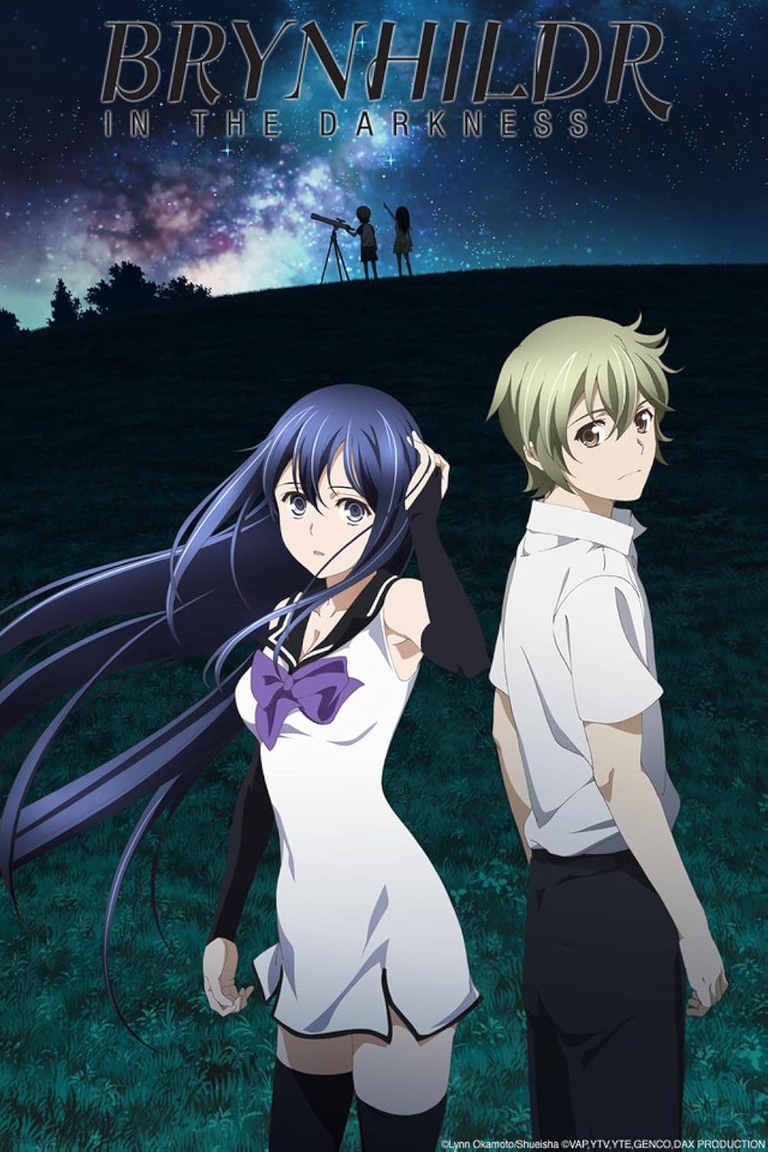
Brynhildr in the Darkness anime review discussions ten years later still sound confused because nobody can agree on what this show was trying to be. You start with a premise about modified girls with alien parasites fused to their necks who will die within two days if they don't take special medication, and by episode six you're watching them compare breast sizes at the beach. That's the kind of whiplash we're talking about with this 2014 Studio Arms production based on Lynn Okamoto's manga, the same guy who wrote Elfen Lied. If you go in expecting something as cohesive as that earlier work, you're going to have a bad time, but not for the reasons you might think.
The setup initially hooks you. Ryouta Murakami is a high school student with a photographic memory who's obsessed with astronomy because his childhood friend Kuroneko died trying to prove aliens exist. He blames himself for her death. Ten years later, a transfer student named Neko Kuroha shows up looking exactly like an older Kuroneko, and she has superpowers. She can break stuff with her mind. She also has a device implanted in her neck called a harnest that contains an alien slug, and without daily pills provided by the evil organization that created her, her body melts or bleeds out in a gruesome death. This is dark stuff. This is heavy. You've got these girls living on literal borrowed time while being hunted by assassins, and Ryouta decides to protect them while hiding them in the school's astronomy club. For the first three episodes, it genuinely feels like a sci-fi horror thriller with real stakes.
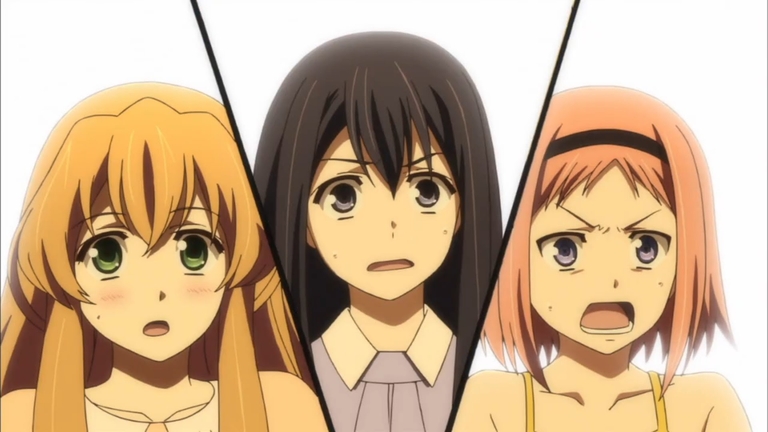
Then Kazumi shows up around episode four, and the whole thing goes off the rails. Kazumi is a hacker witch who is also obsessed with sleeping with Ryouta, and suddenly the show decides it wants to be a harem comedy with graphic violence sprinkled on top like weird seasoning. You'll have a scene where a character gets graphically dismembered and melts into a puddle of gore, and then immediately cut to the girls accidentally grabbing each other's breasts in the astronomy club room. The tonal whiplash is brutal. Apparently this was expected from Studio Arms since they were also responsible for Queen's Blade and Ikki Tousen, but that doesn't make it any easier to watch when you're trying to care about these girls dying horrible deaths while the camera zooms in on their underwear.
The pacing of Brynhildr in the Darkness is probably its biggest crime after the tone issues. The first four episodes move slowly, taking time to establish the rules of the neck devices and the pill mechanics, setting up the mystery of whether Neko is actually Kuroneko, and building the threat of the organization. Then around episode nine, someone apparently realized they only had thirteen episodes to wrap this up, and the whole thing accelerates into a brick wall. Characters get introduced in the opening credits but don't show up until episode eleven. Major plot points about the aliens, the origin of the witches, and the organization's goals get glossed over or ignored entirely. The ending feels like a season finale rather than a series conclusion, with two characters appearing in the epilogue with zero explanation of how they got there or why they're alive.
Ryouta as a protagonist is frustrating because he's simultaneously too smart and too stupid to be believable. He's got that photographic memory, so he can recall entire textbooks to solve problems, and he uses this to figure out how to save the girls from various death flags predicted by Kana, the wheelchair-bound precognitive witch. That's cool. It's nice to have a harem lead who actually contributes intellectually instead of just accidentally falling into girls. But then he'll turn around and make the dumbest possible decisions in emotional moments, or he'll give these cringeworthy speeches about protecting his vulnerable girls that come off as patronizing. He talks about protecting them constantly, even though most of these witches could rip him in half with their powers. The power imbalance makes his white knight routine feel weird, especially when the show keeps sexualizing these same vulnerable girls he's trying to save.
Neko Kuroha suffers from amnesia, which is the laziest trope in the book, and the show drags out the is-she-Kuroneko mystery way too long while giving her almost no personality beyond being sweet and powerful and confused. When she loses her memories again later in the series, it feels like the writers running in circles because they didn't know how to develop her beyond the initial mystery. Kazumi is even worse, not because she's a bad concept, a genius hacker who uses her powers to manipulate technology could be cool, but because the show reduces her to a walking fanservice machine who keeps trying to molest Ryouta while making self-deprecating jokes about her own breast size. It's uncomfortable to watch, especially given that these girls are supposed to be sixteen years old and living with the trauma of being lab experiments who could die any day.
Kana, the quadriplegic girl who can predict deaths, is treated with slightly more respect, but she mostly exists as a plot device to create tension that Ryouta can then solve with his big brain. Kotori, who shows up later, is even more of a walking deus ex machina, introduced solely to have a specific healing power that resolves impossible situations, then gets relegated to background status. The villains are faceless and boring, just generic lab coat guys or other witches who show up to fight and die without any real motivation explained. You never learn why the organization is making these girls, what the aliens actually want, or what the endgame was supposed to be.
The animation quality is decent when it wants to be. The character designs are soft and generic, looking like a knockoff of visual novel art rather than Lynn Okamoto's distinct style from the manga. The dark color palette fits the horror elements when the show remembers it has them, but the background art is often muddy and indistinct. The real crime is the CGI used for vehicles, which looks horrendous, like something from a PlayStation 2 cutscene. Action scenes often happen off-screen to save budget, which is frustrating when you're watching a show about girls with superpowers fighting each other. There's also the censorship issue, the broadcast version uses bright white light and fog to cover up the gore and nudity, which makes some scenes literally unwatchable because half the screen is whited out, though some viewers might prefer that given how gratuitous the uncensored fanservice gets.
The soundtrack is one of the few things that actually works. The background music is heavy on piano and creates genuine atmosphere during the darker moments, and you can listen to it outside the show without wanting to skip tracks. The first opening theme, "BRYNHILDR IN THE DARKNESS -Ver. EJECTED-" by Nao Tokisawa, is this weird disjointed techno instrumental that somehow fits the mood perfectly, representing how disconnected these witches are from normal society. Then they switch to "Virtue and Vice" by Fear, and Loathing in Las Vegas for the last few episodes, which is this jarring death metal scream fest that doesn't match the show at all and feels like it belongs to a different anime entirely. The English dub is rough too, with some voice actors sounding like they're reading lines for the first time, though the Japanese track has its own issues with emotional delivery during the more melodramatic scenes.
By the time you reach the final episode, you've got more questions than answers. What happened to the alien plot that was mentioned in episode one? Why do some witches have completely overpowered abilities that break the established rules? What was the organization's actual goal? The show ends with a ridiculous twist that comes out of nowhere, resolves nothing, and then slaps a happy ending credit sequence over what should have been a tragic conclusion. It feels like the adaptation team got to episode thirteen and realized they were out of time, so they just picked a random stopping point from the manga and called it a day. Apparently they skipped entire arcs and condensed major plotlines to fit into thirteen episodes, and it shows in every rushed conversation and unexplained powerup.
Some people defend this show as a guilty pleasure, and I get that. When it focuses on the survival horror aspect, the tension of these girls trying to live normal high school lives while knowing they could die horribly at any moment, it works. The scenes where they run out of pills and you see the clock ticking on their lifespans are genuinely stressful. But then the camera has to linger on a bath scene or a breast groping joke, and the mood is shattered. You can't have a scene where a character melts into a puddle of blood and flesh in one minute, then cut to the protagonist accidentally walking in on a girl changing the next minute, and expect the audience to take either tone seriously.
Brynhildr in the Darkness anime review scores are all over the place because of this identity crisis. You've got people rating it low because it's a mess, and people rating it high because they liked the character designs or the premise, but almost nobody calls it a coherent story. The manga apparently handles the plot much better with more time to develop the characters and resolve the mysteries, so if this premise sounds interesting to you, I'd honestly point you toward reading that instead of watching this adaptation. The anime isn't just bad because of the fanservice or the pacing, it's bad because it doesn't respect its own story enough to pick a tone and stick with it.
If you're going to watch it anyway, and plenty of people do out of curiosity because of the Elfen Lied connection, go in knowing what you're getting. You're getting a show that starts as a dark sci-fi thriller about escaped experiments fighting for survival, transitions into a mediocre harem comedy with too much bath scene footage, then tries to cram a season's worth of plot resolution into two episodes while forgetting to explain half the lore. You're getting characters who will grow on you despite the writing, animation that ranges from passable to PS2 cutscene, and an ending that will make you throw your hands up in the air and ask what the hell just happened. It's not the worst anime you'll ever see, but it's definitely one of the most frustrating, because you can see the good show hiding underneath all the mess, and it just never manages to break free.