
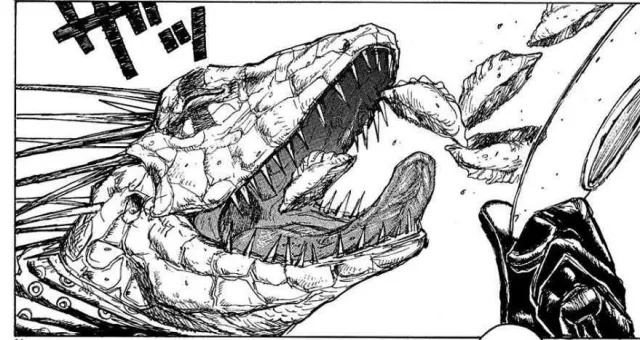
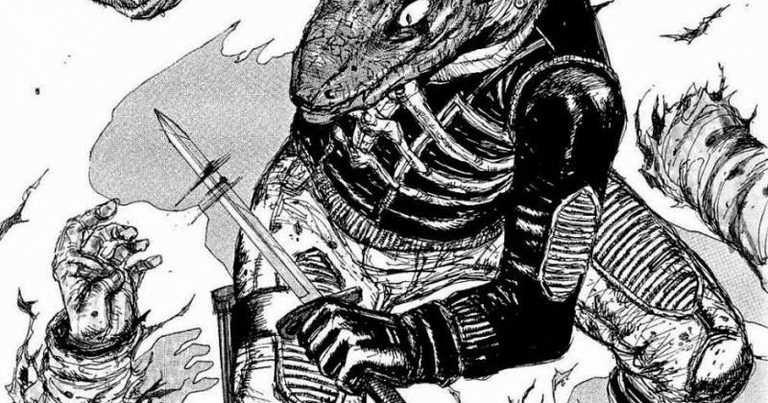
Dorohedoro art style and world-building analysis starts with admitting the obvious: this series looks like it smells bad. Q Hayashida draws like she dipped her pen in motor oil and ash. The pages feel gritty. Characters have pores, stains, and weird lumps. Nothing is clean. That is entirely the point and it is what separates this manga from every other dark fantasy series sitting on the shelf.
Hayashida has gone on record saying she hates smooth aesthetics. She thinks clean lines are boring. Instead she uses charcoal, ink, paint, and markers all at once. The result is this corroded, polluted look that perfectly matches the setting. When you look at panels of The Hole, you can practically taste the toxic rain and metal dust. The art does not just show you a poor neighborhood, it makes you feel the grime under your fingernails.
The Grunge Look Is Deliberate
Most manga artists refine their style to get cleaner as they go. Hayashida did the opposite. Early volumes are rough, sure, but by the end of the 23-volume run, the art is still messy on purpose. She wants that junkyard vibe. Stitches, splatters, and smudges are not mistakes, they are the language of the book.
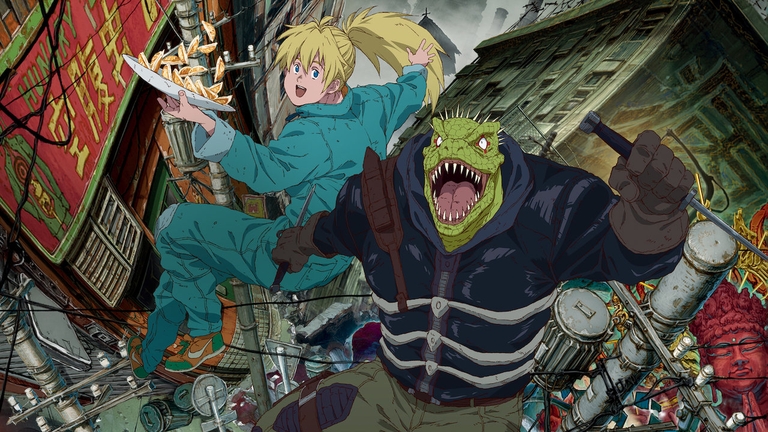
This presented a unique problem for the anime adaptation. Studio MAPPA realized early that traditional 2D animation would sterilize the look. Smooth cel shading would kill the soul of it. So they went with CGI. People complain about CGI in anime usually, but here it was the only way to keep those textured lines and weird proportions intact. The models have this chunky, physical presence that 2D would have flattened out. MAPPA's CGI choice preserved the manga's roughness instead of polishing it away.
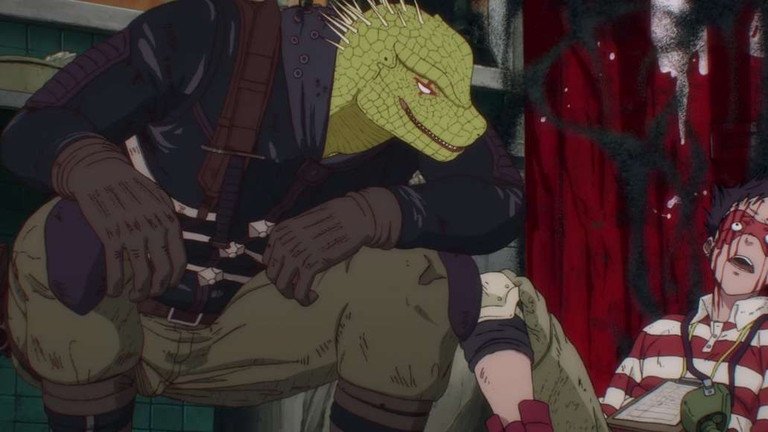
The character designs refuse standard beauty standards. Kaiman has a lizard head and human teeth. Nikaido looks like a cool older sister who could beat you up. En wears a mask that looks like a heart-shaped gas filter. Everyone has distinct silhouettes and fashion sense that draws from punk, military gear, and industrial work clothes. Even background characters get detailed outfits. Nobody wears the same generic fantasy robes you see in other series.
Two Worlds Built on Class War
The world-building in Dorohedoro functions as a direct attack on social hierarchy. You have two dimensions: The Hole, where humans live in squalor, and the Sorcerers' world, which looks like modern Japan but with magic. The Sorcerers treat The Hole like a testing ground. They portal in, experiment on humans, and leave. The toxic rain that falls on The Hole is literally waste from their magic use.
This is not subtle metaphor. Humans are the proletariat and Sorcerers are the bourgeoisie. The Sorcerers have modern apartments, convenience stores, and fashion blogs. The Hole has crumbling concrete and mutated wildlife. The class structure determines everything about how characters live and die.
Within Sorcerer society, you have another hierarchy based on smoke production. High-class Sorcerers generate tons of magic smoke and have fancy abilities. Low-class ones barely produce any. The Cross-eyes are Sorcerers who cannot produce smoke naturally, so they use black powder to boost themselves. They became a feared terrorist group specifically because they threaten the elite who look down on them. The story makes you root for these revolutionaries even when they do horrible things.
What makes this world-building smart is that neither side is purely good. Humans in The Hole are victims, yes, but they are also violent and desperate. Sorcerers are oppressors, but many of them are just trying to live their lives, working dead-end jobs or running small businesses. The moral complexity comes from the system itself, not from individual mustache-twirling villains.
Magic That Refuses to Explain Itself
Most fantasy series give you a magic system with rules, levels, and training arcs. Dorohedoro tells you to figure it out yourself. Magic here comes from Devil Tumors in Sorcerer heads. Each person produces unique black smoke that does one specific thing. En turns things into mushrooms. Shin can cut people without touching them. Noi heals by reconstructing bodies.
There are no power levels. You cannot say En is stronger than Shin in a general sense. Their abilities are just different. Some are useful in combat, some are useless for fighting but great for party tricks. The series treats magic as a biological function rather than a skill to master. You are born with what you have and that is that.
This approach works because it keeps the focus on character conflicts rather than power scaling. Fights are won through clever application of weird abilities, physical combat, or just having bigger muscles. Noi is scary not because her magic is overpowered, but because she is built like a tank and knows how to fight. The absurd magic creates situations where a meat pie cooking contest is just as tense as a death match.
Visual Storytelling Through Filth
The environments tell stories without words. The Hole looks like a city that lost a war decades ago and never rebuilt. Buildings are held together with scrap metal and tarps. The streets are perpetually wet from that toxic rain I mentioned. Everything is brown, gray, and rust-colored.
Compare that to the Sorcerer world, which has clean hospitals, organized crime offices with modern furniture, and even a baseball stadium. The contrast hits you in the face every time the story jumps between worlds. You understand immediately why humans hate Sorcerers. It is not just the experiments, it is the fact that Sorcerers live in comfort while humans breathe poison.
Hayashida draws food better than most manga artists draw action scenes. The gyoza at Nikaido's restaurant look real enough to make you hungry. This serves a weird tonal function. In the middle of all this body horror and violence, you get these slow, detailed scenes of characters eating comfort food. It grounds the fantasy in reality. People still need to eat, joke around, and pay rent even when they have lizard heads or magic powers.
The Horror and Humor Balance
Dorohedoro should be depressing. The setting is a polluted hellscape where humans are lab rats and death is cheap. But it is not depressing because the characters refuse to act like they are in a tragedy. They act like people. They throw birthday parties, play baseball, and argue about dumplings.
This tonal whiplash is intentional. The dark humor comes from characters treating insane situations as normal. Kaiman interrogates Sorcerers by biting their heads and talking to the person inside his mouth. That is a ridiculous concept played straight. The comedy lands because the art is detailed enough to make the violence feel real, but the reactions are casual enough to break the tension.
The body horror is graphic. Heads explode, bodies mutate, and surgery scenes show every stitch. But Hayashida draws it with the same messy enthusiasm she draws everything else. It is gross, sure, but it is also kind of beautiful in how committed it is to the bit. Nothing is sanitized.
Subverting Every Fantasy Trope
Sorcerers should be ancient wizards in robes, right? Wrong. They wear hoodies, leather jackets, and sneakers. They drive cars and work office jobs. The Sorcerer boss En runs a massive business empire with paper trails and accountants. This is not medieval Europe with magic slapped on top. This is a modern capitalist society that happens to have magic instead of electricity.
Even the Devils, who are basically gods, act like bored office workers or petty tyrants. Chidaruma, the main Devil, wears a tracksuit and plays video games. He created the entire Sorcerer race on a whim and now treats them like toys. This undercuts the typical fantasy reverence for divine beings. There is no grand prophecy or chosen one narrative. Just a bunch of people trying to survive in a system rigged against them.
Kaiman's true identity ties into this subversion. He is not a cursed prince or a hero. He is a byproduct of class violence, literally created from the collective hatred of the oppressed. His split personalities (Kaiman, Aikawa, and Kai) represent different responses to trauma. The story treats this not as a mental illness to be cured, but as a literal manifestation of social war.
Why the Manga Demands Your Attention
Reading Dorohedoro is exhausting in the best way. The plot twists constantly. Halfway through, you think you know what is happening, then the second half throws in time travel, devil politics, and a whole backstory about a guy who jumped into a lake of toxic waste to become magic. It is chaotic but never random. Every weird detail connects eventually.
The anime only covered part of the story. It skipped the Bonus Curses, which are short chapters that expand the world with slice-of-life moments. The manga rewards rereading because Hayashida plants clues volumes ahead of the reveals. That messy art style I mentioned earlier hides details in the background that become important later.
Q Hayashida created something that looks like nothing else. The art style influenced a generation of manga artists who realized they did not have to draw clean to get published. The world-building proved you can mix horror, comedy, and political commentary without compromising any of them. The complete madness of the series sticks with you because it feels honest. Life is gross, unfair, and weird, but people still find reasons to laugh and eat gyoza together.
Dorohedoro art style and world-building analysis comes down to this: Hayashida built a universe that is ugly on purpose to tell a story about how ugly systems of power are. The rough lines and polluted backgrounds are not just set dressing. They are the point. When you finish the last volume, you do not feel like you read a fantasy story. You feel like you survived a trip through a garbage dump that somehow had a heart buried in the trash.