
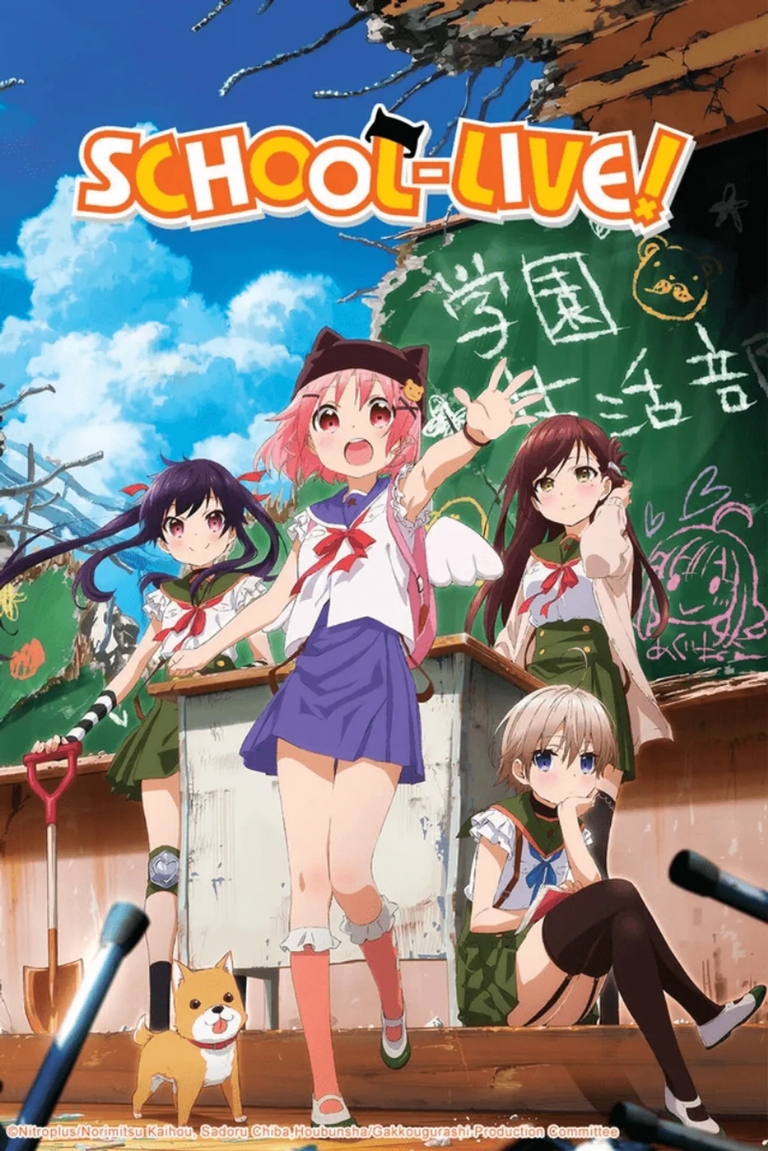
Gakkou Gurashi explained starts with a simple truth that changes everything. The first episode lies to your face and most viewers don't realize it until the final thirty seconds. You think you're watching another boring slice-of-life anime about cute girls drinking tea in a club room. Then the camera pulls back and you see the broken windows, the bloodstains, and the barricades. The school is a ruin. The city is dead. And Yuki Takeya, the pink-haired protagonist grinning at the camera, is completely out of touch with reality.
This isn't just a gimmick to get clicks or shock value. The show doesn't drop the zombie apocalypse twist just to scare you and then become a standard survival horror. It keeps the cute aesthetics running alongside the horror for the entire season. That tension between the moe art style and the crushing reality of the end of the world is the whole point. Gakkou Gurashi is about how we lie to ourselves to keep living when everything falls apart, and the themes and twists serve that idea exclusively.
The First Episode Trap and How It Works
Studio Lerche knew exactly what they were doing when they put this out. The early key visuals looked like every other Manga Time Kirara series. Happy girls in uniforms holding tea cups and smiling. The opening theme "Friend Shitai" is upbeat and bubbly. It screams "buy the bluray for the character songs." Then you watch the episode and it's all classroom shenanigans. Yuki talks to her teacher Megu-nee about graduation plans. Kurumi swings a shovel around but it's played for laughs like she's just an energetic sports girl. The dog Taroumaru runs around being cute. You think you know what this is. You've seen K-On. You've seen Lucky Star. This is that.
The ending of that episode hits like a truck. The camera reveals that the "classroom" is a trashed ruin with desks piled against doors. The students Yuki was talking to are gone. The "class activities" are survival tactics. Megu-nee is a hallucination. The other girls, Yuuri and Kurumi, are barely holding it together as they play along with Yuki's delusion to keep her functional. It's not just a twist. It's the premise. The show never becomes what the opening promised. Instead it uses that promise against you.
If you go back and watch the OP after finishing the series, it's a different experience entirely. The backgrounds slowly rot as the song plays. The character positions shift. Little details like broken glass or zombie silhouettes appear in the second half of the run. The song stays the same but the visuals tell the truth. This isn't fanservice for rewatch value. It's the show telling you from minute one that it was never honest with you. The marketing was part of the story. Some fans figured out the twist early just from the promotional art having too many shadows, but most people walked in blind.
Why Yuki's Broken Mind Is The Core Theme
People call Yuki annoying when they first watch this. They say she's stupid or that her voice is too high. They miss that she's a textbook case of severe PTSD-induced psychosis. Her mind snapped when the outbreak happened. She literally cannot process that her friends are dead and the world ended. So her brain built a wall. She sees the school as it was before. She sees Megu-nee as alive. She has conversations with people who aren't there and the show treats these as real scenes until it pulls the rug out.
The show never treats this as a joke. When Yuki talks to empty space, the other girls don't mock her. They play along because they need her to stay functional. Kurumi needs someone to remind her why she's killing zombies with a shovel. Yuuri needs to believe they're still a school club and not just survivors waiting to die. Yuki's madness keeps the group sane. It's weird and uncomfortable but it's the glue holding them together. Without her delusion forcing them to maintain routines, they would have collapsed into despair weeks ago.
There's a visual cue that sells this. Yuki's hat. When she's wearing her little bucket hat, she's in her safe world. The colors are bright and the music is cheerful. When she takes it off, usually involuntarily, the color palette drains to grey. She sees the blood. She sees the zombies. The hat is her mental switch. The animators use this without ever explaining it in dialogue. You just notice it after a few episodes. That's solid craft.
The Five Stages Theory And Why It Holds Up
Some fans noticed the cast maps roughly to the five stages of grief. Yuki is denial. She lives in a fake world and rejects the truth. Kurumi is anger. She beats zombies to death with a shovel and barely controls her rage at the situation. Yuuri is depression. She puts on a mom act but she's falling apart inside and holding a stuffed animal for comfort. Miki, who joins later, is bargaining. She tries to negotiate with reality by being logical and strict, thinking she can trade rules for safety. And Megu-nee, the dead teacher, is acceptance. She knew they were doomed and sacrificed herself anyway so the girls could live.
It's not a perfect one-to-one match but the theory holds up enough to be intentional. Each girl processes the apocalypse differently. The show bounces between their viewpoints to show you how trauma fractures people. One person sees a fun school festival. Another sees a suicide mission to get supplies from an infested courtyard. The same event is simultaneously happy and horrifying depending on whose eyes you're looking through. That's the whole show in one sentence.
The Megu-nee Twist Is Deeper Than You Think
The Megu-nee reveal is the best twist in the series. Better than the first episode reveal. For several episodes you see this clumsy teacher interacting with Yuki. She gives advice. She trips over herself. She seems like comic relief. Then you realize she never talks to anyone except Yuki. She appears in places she couldn't physically reach. She walks through doors that are barricaded. She's a ghost created by Yuki's guilt and need for authority.
But the show doesn't stop there. Megu-nee isn't just a hallucination. Her real body is still in the school. She's a zombie trapped in the basement behind a barrier. When the girls need to get medicine for Kurumi after she gets bitten, they have to confront zombified Megu-nee. Yuki has to face that her imaginary friend is a corpse trying to eat her friends. That's messed up. It's psychological horror that hits harder than any jump scare because you cared about the imaginary version of this character.
Megu-nee represents the failure of the adult world. She died protecting the girls but she also represents the system that failed to prevent the outbreak. The school was supposed to be safe. The adults were supposed to fix things. Instead she's a monster in the basement. The girls have to save themselves because the adults are either dead or infected.

What The School Building Really Represents
Megurigaoka Private High School is too convenient. It has solar panels. It has a water purification system. It has a rooftop garden and secure fencing that somehow held for months. The show explains this eventually. The faculty knew something was coming. The Randall Corporation or some bio-weapon division had ties to the school. The building was designed as a shelter, or at least the faculty section was.
Critics point out that the infrastructure is unrealistic. A high school doesn't have military-grade supplies. The manga goes deeper into the conspiracy but the anime hints at it through locked doors and emergency manuals. The way the outbreak seemed to happen during a drill suggests the adults knew and failed anyway. The school becomes a graveyard of good intentions. It was meant to save people but it became a tomb.
The building itself is a character. When it stands, the girls have hope. When the power fails and the zombies get in during episode ten, the sanctuary becomes a death trap. The architecture mirrors their mental state. Safe and contained until it isn't.
Miki And The Problem With Being Too Logical
Miki Naoki wasn't in the original group. She was surviving in a mall with her friend Kei. When Kei left the safe room and died, Miki shut down. The School Living Club found her and she joined them. She immediately clashes with Yuki because Miki sees the danger clearly. She doesn't have the luxury of delusion yet. She thinks Yuki is a liability who will get them killed.
Her arc is about learning that pure logic doesn't save you. She tries to be the sensible one but she ends up needing the group's emotional support just as much as they need her pragmatism. She finds the truth about Megu-nee first by reading the graduation album and seeing the teacher died months ago. She has to decide whether to break Yuki's mind or let the lie continue. That's a heavy choice for a high schooler. She chooses to protect the lie because she sees that Yuki's happiness keeps Kurumi and Yuuri going.
Miki represents the audience's perspective. She comes in late, she thinks the situation is insane, and she has to learn the rules of this broken world. Her growth from cynic to someone who understands the value of their pretend school life is the emotional backbone of the middle episodes.
The Visual Language Of Delusion
The cinematography deserves more credit than it gets. When Yuki is in control of a scene, the camera is steady and the colors are warm and saturated. When reality breaks through, they use fish-eye lenses and dutch angles. The background art shifts from clean lines to rough sketches. It's subtle but it makes your brain uncomfortable before you know why.
Look at the windows. In Yuki's world, they show blue sky. In reality, they're boarded up or broken. The lighting is key. The school is always dimly lit except in Yuki's fantasy sequences. The zombies are rendered in CGI while the girls are 2D animation. This separation makes them look wrong, like they don't belong in the same world. When a zombie attacks, the frame rate changes. Everything stutters. It feels like a broken machine.
The show also uses silence effectively. Most zombie media has constant moaning. This one has long stretches of quiet where you can hear the wind or the generator hum. Then a shovel hits a skull and the sound is sharp and awful. The contrast makes the violence worse. The soundtrack switches between bubbly slice-of-life music and dissonant horror tracks without warning.
Episode Ten And The Collapse Of Safety
The midpoint lull annoys some people. Episodes four through nine focus heavily on slice-of-life moments. They have a pool day. They test their emergency supplies. It feels slow. Then episode ten happens. The barricades fail. The zombies get in. Kurumi gets bitten by zombified Megu-nee in the basement. Yuuri has a complete breakdown and nearly kills a survivor. The school, their sanctuary, becomes a death trap. The illusion shatters completely.
This is where Taroumaru dies. The dog gets infected and the girls have to put him down. It's brutal because the show made you care about that dog. He represented normalcy and innocence. When he goes, you know nothing is safe. The episode ends with the girls standing in the rain watching their home burn. It's the lowest point.
The pacing is deliberate. The slow episodes lull you into the same false sense of security the characters have. Then the violence is sudden. There's no gradual build-up. One minute they're having tea. The next minute they're fighting for their lives. That's how trauma works. That's how the show differentiates itself from standard horror.

Gakkou Gurashi Explained The Final Message
They escape. They find other survivors. Yuki finally accepts the truth and "graduates" from her delusion. She gives a speech about moving forward. It seems hopeful. But look at what they lost. The school is gone. Megu-nee is confirmed dead. Kurumi is infected and running on borrowed time thanks to an experimental cure that might not last. Yuuri is barely holding her mind together and clings to a stuffed animal as a replacement for her dead sister.
The anime ends with them driving toward a new location, Saint Isidore University. The manga continues and gets even darker with other factions of survivors and more conspiracy details. But the anime's ending is ambiguous enough to hurt. They survived, but survival isn't living. They're just continuing because stopping means dying. The graduation ceremony they hold is fake. The diplomas are worthless. But the act of holding it matters. It says "we are still human and we still mark time."
Gakkou Gurashi explained properly isn't a zombie show. It's a show about mental illness and coping. The twists work because they serve the characters, not the other way around. Yuki's broken mind, Megu-nee's double death, the school's secrets, they all point to the same idea. We tell ourselves stories to survive. Sometimes those stories are school clubs and tea parties. Sometimes they're just the hope that tomorrow might be better than today.
If you dropped this show after episode one because you thought it was just shock value, you missed the point. If you dropped it in the middle because it was too slow, you missed the payoff. It's a messy, weird, sometimes frustrating series that commits to its bit harder than almost any other anime. The moe aesthetic isn't a trick to get you to watch horror. It's the whole message. You can find moments of joy inside absolute hell. That's not just a theme. That's the only reason any of us keep going. The show hides its dark story behind bright colors but the darkness is always there, waiting for the characters to look up.