
Liz and the blue bird anime movie analysis usually starts with people calling it a yuri story or a music drama and that's already wrong. This film is about two girls who love each other so much they're suffocating and the only way to survive is to learn how to walk away from the thing keeping them alive. Director Naoko Yamada didn't make a romance or a coming of age story about finding your voice, she made a horror movie about codependency where the monster is kindness and the weapon is a flute and an oboe playing out of sync.
Mizore Yoroizuka plays oboe and she's quiet in a way that makes you uncomfortable. She doesn't talk to people. She stands too close to Nozomi Kasaki who plays flute and everyone assumes Nozomi is the confident one because she smiles and talks loud but that's the trick. Nozomi is scared that Mizore is better than her and Mizore is scared that Nozomi will leave again like she did in freshman year when she quit band without warning and made Mizore so sick she couldn't play for weeks. They're broken in complementary ways and the movie knows you can't fix that with a conversation because they've been friends for three years and still don't know how to say what they need.
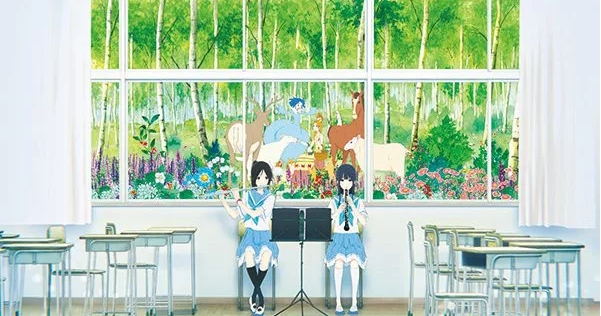
The story they're playing in the competition is called Liz and the Blue Bird and it's a fairy tale about a lonely girl who finds a bird that turns into a girl and lives with her but the bird has to leave because she's a bird and Liz has to let her go because she loves her. At first Mizore thinks she's Liz and Nozomi is the bird who will fly away after graduation. She thinks she's the one holding on too tight and she plays her part like she's begging the bird to stay. But she's got it backwards and that's why the music sounds wrong. She's the bird. She's the talented one who got scouted for music college while Nozomi is staying local. She's the one who needs to fly but she's been clipping her own wings because she's terrified that if she gets better Nozomi won't love her anymore.
Nozomi realizes this during practice when Mizore plays the third movement with actual emotion for the first time and it breaks her heart because she hears how good Mizore is and how much she's been holding back to protect Nozomi's feelings. That's the worst part. Nozomi has been the cage the whole time and she didn't even know she built it. She thought she was being a good friend by keeping Mizore close and dragging her to social events but she was really keeping Mizore small because if Mizore grows up Nozomi gets left behind in the dust. High school ends and everyone goes their separate ways and this movie understands that some friendships aren't built to survive adulthood but that doesn't make them less real.
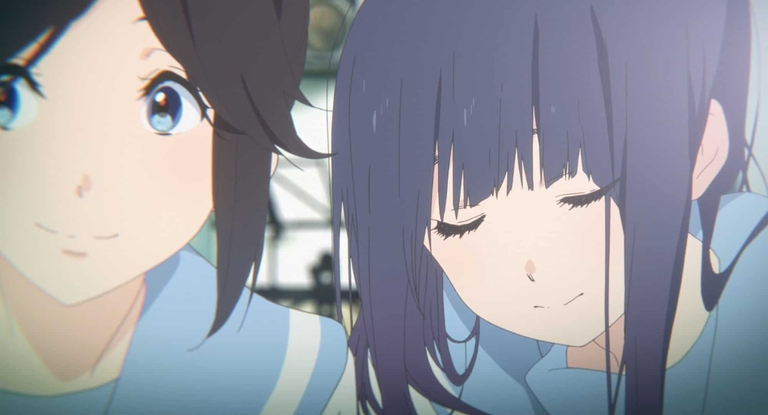
Yamada films this like she's watching through a keyhole. She focuses on feet walking down hallways and hands twisting hair and fingers touching instrument keys instead of showing faces during important moments. There's a scene where Mizore is stressed and she plays with her hair and Yamada zooms in so close you can see the individual strands wrapping around her finger and that's the whole movie right there. Words fail these girls so the camera has to catch the body language instead. When they talk they lie or they say half-truths or they say nothing at all. The real conversation happens in the space between them when they're sitting on the stairs and not looking at each other or when Nozomi is walking ahead and Mizore is following two steps behind like she's afraid to close the gap.
The sound design by Kensuke Ushio uses prime number rhythms so the footsteps don't match the music on purpose because the characters are out of sync. He recorded actual classroom sounds at a real school and layered them under everything so you hear chairs scraping and doors closing and the ventilation system humming and it makes the whole thing feel like you're sitting in the room with them sweating through your uniform. The fairy tale sequences use watercolor animation that looks like a children's book come to life with soft edges and bright colors that hurt to look at because they're so pretty compared to the gray realism of the school hallways. Some people call this visual inconsistency but they don't get it. The fantasy is supposed to feel fake because it's a story Mizore is reading to understand her own life and she's got the metaphor wrong until the end.
Ririka shows up as the new oboe girl and she's aggressive about being friends with Mizore in a way that scares her because Ririka just says what she thinks. She tells Mizore she's weird and she likes it and she wants to hear her play and she doesn't play games. Ririka is what Mizore could have if she wasn't obsessed with Nozomi and the movie uses her to show that Mizore isn't actually incapable of social connection, she's just poured everything into one person who can't carry the weight. Natsuki and Yuko from the main Sound Euphonium cast show up too but this works as a standalone movie because you don't need to know their history. You just need to see that other people notice how weird the Mizore-Nozomi bubble is and they try to pop it but the girls won't let them in.
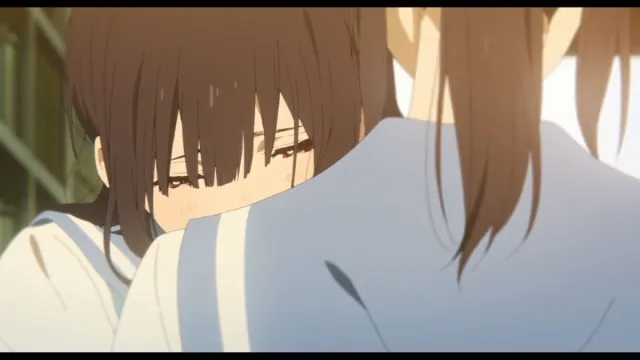
The climax isn't the concert. The concert happens and they play fine but that's not where the movie lives. The real ending is when they finally talk for real in the practice room and Mizore says she loves Nozomi's hair and the way she walks and basically everything about her and Nozomi realizes she's been taking Mizore for granted while Mizore has been worshipping her like a god. The hug they share, the Daisuki no Hagu, is messy and desperate because they're saying goodbye even while they're holding on. Nozomi has to open the cage and push Mizore out because if she doesn't Mizore will stay inside forever and rot. That's love in this movie. It's violent and sad and necessary.
People argue about whether this is a gay movie or just a really intense friendship and honestly that debate misses the point entirely. Mizore's feelings are obsessive and romantic in every way that matters whether they sleep together or not. She literally cannot function without Nozomi in her orbit and that's not healthy regardless of what label you slap on it. The movie isn't trying to define their relationship for you. It's showing you what it looks like when two people fuse their identities together so completely that separating feels like dying. Whether you read it as queer subtext or just teenage intensity, the pain is the same.
Some viewers call this movie boring because nothing happens. There's no explosion, no kiss, no big dramatic fight where someone slaps someone else. The stakes are microscopic. Will the band play well at the competition? Will Mizore apply to music school? Will they fix their communication issues? These are small questions but they feel enormous when you're eighteen and the person standing next to you is your whole world. If you think this is boring you probably haven't been that lonely or that scared of losing someone. The movie demands you pay attention to micro-expressions and the rhythm of breathing and the way light hits hair at sunset. It rewards patience with moments so intimate they feel like you're intruding.
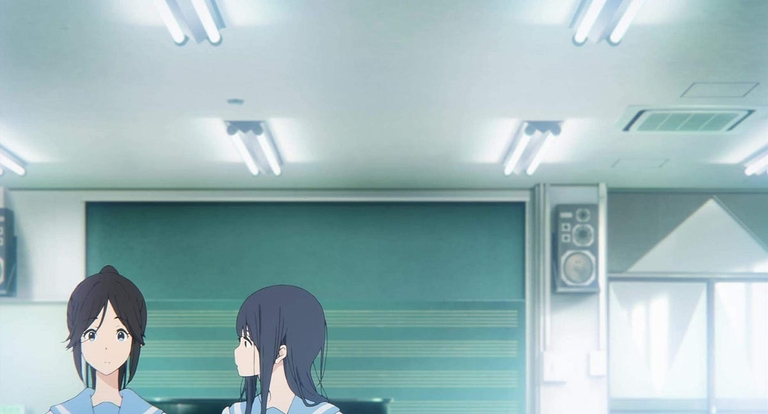
The final scene is ambiguous on purpose. Nozomi turns back to Mizore after they've said their goodbyes and the sound cuts out and we don't know what she says. The camera stays on Mizore's face looking surprised and then the credits roll. Some people think Nozomi says I love you back. Some people think she asks if they can meet tomorrow. Some people think she says nothing and Mizore is just reacting to the wind. That's the point. The cage is open. The bird is flying. What happens next isn't part of this story because Liz and the Blue Bird isn't about the future. It's about the terrifying moment when you realize you have to let go of the thing you love most because holding on is killing both of you.
Liz and the blue bird anime movie analysis often gets bogged down in trying to solve the puzzle of who is Liz and who is the bird but the movie tells you straight up that they swap places. Everyone is both the keeper and the kept. Everyone is both the cage and the prisoner. The only way out is to love someone enough to tell them to leave. Mizore plays the oboe alone in the final shot and the sound is beautiful because it's finally honest. She's not playing for Nozomi anymore. She's playing for herself. That should feel like a victory but it feels like a funeral because growing up always does.