
Blue Exorcist Rin Okumura's heritage and internal conflict drives every decision he makes, every fight he picks, and every moment of hesitation you see on screen. He's not just some hotheaded kid who found a cool sword. He's a walking existential crisis with a weapon that barely keeps him from killing everyone around him.
Most anime protagonists get their special ability and they're hyped. They train, they level up, they beat the bad guy. Rin gets his power and realizes it's basically a loaded gun pointed at his own head. He finds out he's the literal biological son of Satan, which means every exorcist organization on the planet would be completely justified in killing him if they knew the full truth. That's not a fun twist. That's a death sentence wrapped in blue fire.
The show doesn't treat this like a cool secret identity he gets to reveal to friends for shock value. It's a burden. When Shiro Fujimoto dies (and yeah, that's a massive spoiler but it's episode one stuff), Rin doesn't just lose his dad. He loses the only person who knew how to keep the leash on his DNA. Suddenly he's got these blue flames that burn everything, a brother who looks at him like he's a time bomb, and a school full of people who would exorcise him on sight if they knew what was in his blood. That's heavy. And it's not the kind of heavy you fix with a training montage and some friendship speeches.
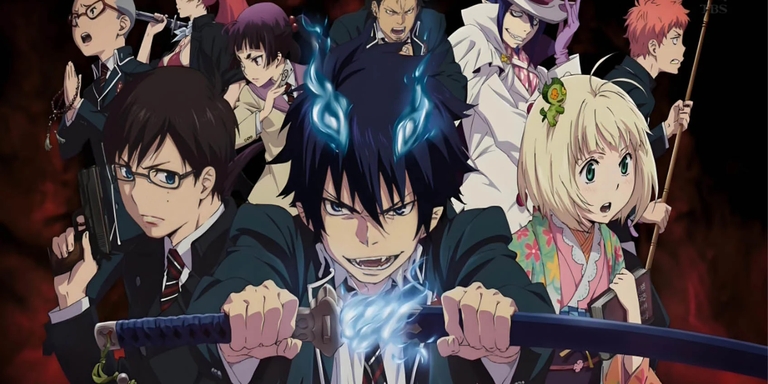
Why Being Satan's Son Is a Curse Not a Blessing
People watch the first episode and think oh cool, demon powers, he's going to be overpowered. They miss the part where those same powers killed his adoptive father figure and marked him for death by the Vatican. Rin isn't just part demon. He's a full Nephilim, which in this universe's lore means he's a direct biological descendant of a demon king with the power to potentially destroy the human world.
The wiki breaks down how his realization of being Satan's son happens at the absolute worst moment possible, simultaneously with the awakening of his latent demonic powers and Shiro's death. That's trauma stacking on trauma. He doesn't get to gradually learn his heritage. It hits him like a truck at the same moment he's watching the only father he ever knew die.
And here's the thing nobody talks about enough. Rin's body is literally trying to transform into something else constantly. The blue flames aren't just a magic ability he switches on. They're the physical manifestation of Satan's power trying to burn through his human shell. Every time he uses them, he's fighting his own biology. It's like being allergic to your own muscles. Sure, he can lift heavy things, but it might kill him in the process.
When Rin's flames ignite, his body temperature spikes to impossible levels, his healing factor kicks in unnaturally fast, and his pain receptors dull to the point where he doesn't notice injuries that should incapacitate him. This isn't a superpower boost. It's his body trying to accommodate a form that isn't supposed to exist in Assiah. The human world rejects him on a cellular level. We see this when he's healing from injuries; his wounds close faster, but the process looks painful and wrong. Flesh knitting together in seconds shouldn't look natural, and the show makes sure it doesn't.
The other students at True Cross Academy aren't just being mean when they side-eye him. From their perspective, he's the equivalent of a walking nuclear weapon with a hair trigger. I saw some discussions explaining how the hostility comes from the existential threat he represents to both human and demon worlds. He's not trustworthy because his blood compels him toward destruction. At least, that's what the textbooks say.
The Kurikara Sword Is Not Just a Weapon
Let's get something straight about that sword Rin carries around. It's not a tool. It's a cage. The Kurikara, also called Koumaken, doesn't just cut demons. It literally contains Rin's demonic heart. According to this breakdown of the sword mechanics, monks from the Myodha Sect sealed his true nature inside that blade at birth specifically so he could live as a human.
While the sword is sheathed, he's got a heartbeat. He's got limitations. He's vulnerable in the ways humans are vulnerable. But when he draws that blade, he releases the seal, and suddenly he's got access to superhuman strength, accelerated healing, and those destructive blue flames. The trade-off is that he risks losing his human consciousness to pure demonic instinct.
The sword is depicted as a double-edged tool that anchors his humanity. If the seal fails or the blade gets damaged, like what happens during the Kyoto Impure King Arc, he risks being consumed completely by his demonic instincts. That's terrifying. Imagine carrying around a sword knowing that if it breaks, you stop being you. You become a monster that hurts everyone you love.
The guard features two overlapping circles representing the intersection of human and demon worlds. The blue hilt matches his flames. When the seal weakens, we see cracks appear in the blade or the scabbard wrappings come loose. These aren't just aesthetic choices. They're warning signs that the prison is failing. Rin has to sleep with the sword, eat with it, shower with it. It's a constant reminder that he can't ever just be a normal guy.
I read this analysis of the symbolism that describes the Kurikara as representing the fragile barrier between his humanity and his destructive inheritance. That's exactly right. It's not a power source. It's a dam holding back a flood. And Rin has to fight every single day to keep that dam from cracking.
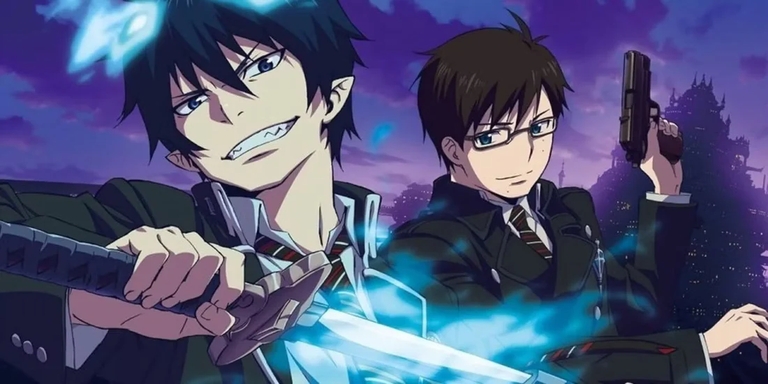
Yukio's Inferiority Complex Makes Everything Messier
The relationship between Rin and Yukio is probably the most psychologically complicated part of this whole show. You'd think Yukio, being the human twin, would be the stable one. He's the prodigy, the teacher, the genius who skipped grades and knows seventeen different ways to kill a demon. But some fans on Reddit pointed out that Yukio suffers from a brutal inferiority complex specifically because of Rin's demonic potential.
Yukio spent his whole life training, studying, pushing himself to be the perfect exorcist so he could protect his brother. Meanwhile Rin sleeps through class, eats like a pig, and can still level a building by accident because of his genetics. That creates a weird resentment. Yukio feels inadequate because no matter how hard he works, he'll never have the raw spiritual power that Rin was born with.
But it goes deeper than jealousy. Yukio is terrified of Rin. He loves his brother, but he also sees him as the thing that might destroy everything. When Yukio acts cold or distant, it's not just teenage angst. It's the psychological toll of knowing your twin brother could accidentally kill you if he has a bad dream and the sword falls off the nightstand.
They shared a womb, but one came out human and one came out a loaded gun. Yukio was born with weak constitution while Rin was born strong even before the flames manifested. That early difference set the tone for their whole lives. Yukio had to become the responsible one, the smart one, the good one, while Rin got to be the screw-up because nobody expected better from the demon kid. But when the truth came out, Yukio realized all his studying was just a way to compensate for the fact that he was fundamentally less powerful than his lazy brother. That eats at a person.
The manga handles this way better than the anime filler did. In the original anime run, Yukio's motivations get muddy and weird. But in the source material, his struggle is consistent. He wants to save Rin from Gehenna, but he also feels this crushing pressure to keep up with Rin's exponential growth while his own abilities plateau. That's a specific kind of hell that doesn't get explored enough in shonen anime.
From Brawling to Actually Thinking
I saw an article tracking how much Rin has changed since the first season, and it's actually crazy when you lay it out. In Season 1, he's pure impulse. He sees a problem, he hits it with the sword, he causes property damage, he gets yelled at. He doesn't think about the consequences of drawing the Kurikara because he's still operating on the idea that power is good and more power is better.
The Kyoto Impure King Arc serves as the brutal turning point where he realizes that mindset gets people killed. His classmates (Suguro, Shiemi, Konekomaru) are terrified of him. Not just wary, but actively scared that he'll lose control and burn them alive. Rin has to prove he's trustworthy, which means he has to stop relying on raw demonic strength and start actually learning technique.
In the Kyoto Arc, when Rin tries to protect the group from the Impure King, he accidentally nearly burns them all because he doesn't know how to throttle the output. He goes from zero to nuclear with nothing in between. Later, we see him learning to light just his sword, then just his hand, then specific controlled bursts. It's like learning to drive a car that has no brakes and an accelerator that sticks. Every lesson requires trusting that he won't kill his teacher.
This is where his fighting style evolves from just swinging the sword while on fire to a disciplined fusion of traditional swordsmanship and controlled energy release. He learns that the blue flames can be used for protection rather than just destruction. That's a huge mental shift. It means accepting that he's not human, but choosing to use his inhuman nature for human benefit.
By Season 3, he's more stable. He's not fixed, because that's not how trauma works, but he's thoughtful. He considers the weight of his actions before igniting those flames. The upcoming Beyond the Snow Saga apparently uses the snowy setting to reflect his pursuit of inner peace and self-control, showing a Rin who has accepted his dual identity rather than fighting it.
The Social Reality of Being a Monster
Let's talk about the day-to-day life of being Rin Okumura. He can't get a normal job. He can't date normally. He can't even eat spicy food without risking an emotional response that might set the table on fire. Every interaction is filtered through the knowledge that he's one bad day away from becoming the villain of someone else's story.
The other exorcists have every right to be scared of him. From their perspective, he's a gateway. If Satan can fully possess Rin or influence him through their blood connection, then Rin represents a direct line between Gehenna and Assiah. He's a security breach walking around in a school uniform.
Suguro Ryuji initially wants nothing to do with him because his family has a history with demons. Konekomaru is actively terrified because he's small and knows one slip-up means death. Shiemi tries to be accepting but has moments where she flinches. These micro-reactions accumulate. Rin sees them. He notices when people tense up when he enters a room. He hears the whispered conversations that stop when he gets close. It's like being a convicted felon in a small town where everyone knows your record, except his crime is existing.
He works part-time jobs that never last because he breaks things or accidentally intimidates customers. He can't form romantic attachments easily because what happens if he gets too excited? The show hints at his crush on Shiemi, but he keeps distance because he knows he's dangerous. That's a specific kind of loneliness that comes from being too risky to love.
What the Blue Flames Really Represent
The blue flames aren't just cool visual effects for the animators to play with. They're Satan's signature. When Rin uses them, he's literally wielding his father's power, and that creates a direct connection between them. Every time he draws on that power, Satan can probably feel it, or at least sense it, which means Rin is constantly advertising his location to the worst being in existence.
There's also the physical toll. Using the flames burns through his stamina differently than normal exertion. His body isn't designed to channel that much demonic energy, even with the Kurikara helping regulate it. When he pushes too hard, we see his skin crack, his fangs extend, and his eyes change. He's physically transforming, and each transformation risks becoming permanent.
The flames burn at temperatures that shouldn't be possible for organic matter to contain. When Rin uses them extensively, steam rises from his body because his blood is literally boiling. The fangs that extend when he's emotional aren't just for show; they're an indicator that his jaw structure is shifting to accommodate a carnivorous diet that demons in Gehenna probably need. These physical changes scare him more than anything because they're irreversible steps toward becoming something that isn't Rin Okumura anymore.
The flames represent a curse of lineage that Rin eventually learns to transform into a purifying force, but that transformation isn't easy. It requires accepting that part of him is always going to be monstrous, and that the best he can do is point that monstrosity at worse monsters.
The Anime vs Manga Problem
I have to mention this because it affects how people understand Rin's conflict. The first anime season diverges from the manga pretty significantly after a certain point. The filler episodes in the original run create this weird tonal whiplash where Rin's struggles get sidelined for monster-of-the-week nonsense.
The manga keeps the focus tight on the psychological pressure. It explores how Rin's heritage affects his brother's mental health, his classmates' trust issues, and his own sense of identity without the distracting filler arcs. If you're trying to understand the real depth of Rin Okumura's heritage and internal conflict, you need to read the manga or watch the Kyoto Saga which follows the source material properly.
The manga also takes its sweet time. After 74 chapters, many plot threads are still unresolved. Only three of the eight demon kings have shown up. The Illuminati arc is just getting started. This slow burn works in the story's favor because it lets Rin's internal struggles breathe. He doesn't get over his daddy issues in three episodes. It takes years of story time for him to even approach acceptance.
The manga also explores the Illuminati's interest in Rin as a specimen. They don't want to kill him; they want to study him, replicate him, use him as a bridge between worlds. This adds another layer to his paranoia. He's not just avoiding exorcists who want him dead. He's avoiding scientists who want to dissect him while he's alive. The anime filler didn't have time for this slow-burn conspiracy, so it rushed to a conclusion that undercut the psychological tension.
Why He Doesn't Just Give Up
At any point, Rin could probably surrender to his demonic side and live in Gehenna as royalty. Satan would welcome him with open arms. He'd be powerful, immortal, and free from the constant fear of hurting people. The fact that he doesn't choose that path is the whole point of his character.
He stays in Assiah, surrounded by people who fear him, fighting a war he's biologically destined to lose, because Shiro Fujimoto loved him. That love wasn't just emotional comfort. It was a choice that Shiro made every day to see Rin as a son rather than a weapon. Rin honors that choice by continuing to fight his own nature, even when it's exhausting, even when it would be easier to just let go.
That's what makes Blue Exorcist different from other demon protagonist stories. Rin isn't embracing his dark side to get stronger. He's constantly rejecting it while still needing to use it to survive. It's like being an alcoholic who has to drink exactly two beers to fight monsters, but if you drink three, you kill your friends. That balance is impossible to maintain forever, and the series keeps building tension around when that balance will finally break.
Blue Exorcist Rin Okumura's heritage and internal conflict isn't just backstory. It's the active, bleeding wound that every plot thread ties back to. Whether he's fighting the Impure King, dealing with Yukio's breakdown, or just trying to get through a school day without setting his desk on fire, he's carrying the weight of being Satan's son. The Kurikara sword helps, his friends help, but at the end of the day, it's him against his own blood. And that's a fight that doesn't end with a final boss battle. It's a daily choice to be human, even when everything in your DNA is screaming at you to burn.