
Sakura Trick anime kiss scenes analysis always starts with someone running the numbers. Haruka and Yuu kiss approximately 4.8 times per episode if you average it out across the whole twelve-episode season, and that statistic tells you everything wrong and everything weirdly right about this show. You have a 2014 Studio DEEN production that treats lesbian romance like a slot machine where every pull results in lip contact, a series so saturated with spit-swapping that episode nine becomes legendary simply because they only bump foreheads by accident.
The show doesn't build to romance. It starts there. Ten minutes into episode one Haruka drags Yuu into an empty classroom because she is jealous about seating charts and they kiss surrounded by falling sakura petals. That is the inciting incident. No slow burn. No yearning glances across three seasons. Just immediate oral fixation because Haruka has impulse control issues and Yuu doesn't know how to say no yet. The rest of the series runs on this engine. Jealousy leads to secret kissing leads to public kissing leads to kissing while someone else is talking in the same room.
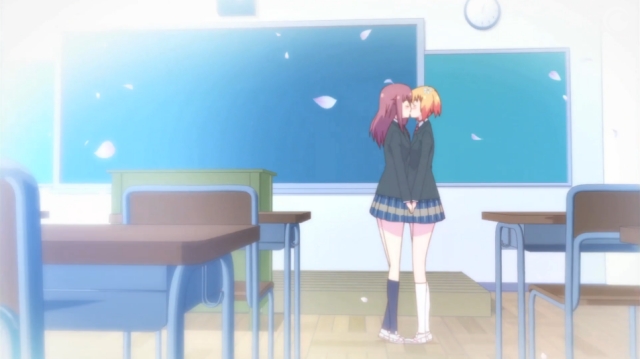
The Quota System Nobody Talks About
People call it the kissing quota. You can feel the production meeting where someone said they need a minimum of three smooches per twenty-two minutes or the audience riots. This creates a weird rhythm where characters manufacture drama just to justify leaning in. Haruka gets clingy over something trivial, Yuu acts hesitant for exactly eight seconds, then they connect while the camera stays perfectly still.
That static camera work is important. Unlike other shows that treat yuri content like ecchi material with panning shots and weird angles, Sakura Trick keeps things eye-level. The lens doesn't leer. It just watches these two dorks panic and collide. The sound design helps too. They record the little chuu sounds super close to the mic, almost whisper-level, which creates this fake privacy bubble. You feel like you're intruding on something personal even when they're doing it on the school roof during lunch hour.
But the quota system gets exhausting. By episode six you can predict the beats. Someone feels insecure, they find a semi-secluded spot, lips meet, roll credits. It becomes mechanical. The kisses stop being events and turn into punctuation marks, periods at the end of sentences that didn't need them. The main plot really is just kissing, and once you clock that pattern the show loses its surprise factor.
Why Episode 9 Hits Different
Then episode nine happens. Haruka and Yuu don't kiss. They try to, kind of, but they mess up and bonk foreheads and spend the rest of the episode dealing with the absence of that contact. Suddenly there is tension. Real tension. Not the fake "will they won't they" because they absolutely will and everyone knows it, but the tension of two people who have built their entire relationship on physical shortcuts having to face each other without the crutch.
This episode proves the staff could write actual romance if they weren't shackled to the gimmick. You see Yuu's uncertainty about whether they are just friends or something more, and you see Haruka's genuine fear of being left behind. They have to talk. They have to use words instead of saliva. It is messy and awkward and feels more intimate than any of the previous makeout sessions because the absence hurts.
Fans noticed. If you dig through old threads, episode nine always gets singled out as the one that understood what the show could have been. It is the exception that proves the rule. When you remove the kissing gacha machine, the characters have to breathe. Some viewers argue this is how romance should be done in all anime, letting the lack of contact sting more than the presence.
Sound Design And The Whisper Close-Up
The audio team knew what they were doing. They mic the kisses close, like ASMR level close. You get that wet chuu sound in your ears at almost whisper volume. This creates a weird intimacy that the visuals sometimes undercut. The camera stays static, sure, but the audio puts you right inside the bubble with them.
Background noise matters too. During these scenes you can hear hallway chatter about tests or lunch or whatever school stuff continuing right over the lip contact. That contrast is deliberate. Their world stops while everyone else's keeps spinning. It is a technique romance movies use with city noise but here it happens every episode until you stop noticing. You get trapped in the cocoon with Haruka and Yuu. The outside voices fade and you are just left with the sound of them breathing and the soft impact.
This creates what some intimacy analysis calls fake privacy. The viewer feels like they are intruding on a personal moment even when the characters are being exhibitionists in public spaces. It is a neat trick that almost makes up for how often they repeat it.
The Side Couple Actually Has Stakes
While Haruka and Yuu are busy filling their lip-locking bingo card, Kotone and Shizuku are in the background dealing with real problems. Kotone has an arranged marriage waiting for her after graduation. She is going to lose Shizuku to societal expectations. That is actual dramatic weight.
Their kisses mean something different. They are not just scratching an itch or satisfying a quota. They are time-limited. Every touch is borrowed time. Kotone plays this confident chess-master role but she is emotionally aggressive because she knows the clock is running out. Shizuku melts from anti-social isolation into someone willing to fight for this, but she starts from a place of fear.
This contrast makes the main couple look worse by comparison. Haruka and Yuu have no external pressure. Their parents aren't trying to marry them off. The school doesn't care. They could just date normally. Instead they create artificial drama about keeping secrets that nobody would actually care about. Kotone and Shizuku have every reason to hide and they still manage to feel more honest than the leads.

Mitsuki And The Only Real Arc
Yuu's older sister Mitsuki starts as the antagonist. She tries to stop the kissing. She is the student council president and she keeps walking in on them. Standard comedy setup.
Then the show does something weird. It gives her feelings for Haruka too. Real feelings. Jealousy that isn't played for laughs. She is closeted and self-hating and uses Haruka as an outlet for emotions she has never had friends to share with. She approaches love like a math problem to be solved.
By episode twelve she accepts that her answer is wrong. Haruka picks Yuu. Mitsuki gets crushed but she grows. She accepts her identity even if she loses the girl. That is the only complete character arc in the entire series. Everyone else stays static but Mitsuki emotionally ascends. She starts as a chaotic force trying to break them up and ends as the most mature person in the room.
It makes you wish the show followed her instead. She has stakes. She has consequences. Haruka and Yuu just have spit.
Public Kissing As Invisibility Cloak
One of the weirdest choices in Sakura Trick anime kiss scenes analysis is how often they do it in public spaces. Hallways. Classrooms. The student council room. Sometimes another character stands three feet away and doesn't react. The show treats this like a comedic bit. Oh look, they are kissing behind a textbook while someone asks about lunch.
Defenders say this is deliberate. The background characters keep talking about tests and weather over the kiss audio. The world keeps spinning while time stops for Haruka and Yuu. That contrast creates a cocoon. You are inside the bubble with them and the outside noise fades.
Critics say it kills stakes. If nobody notices or cares, then the secret relationship angle is fake. There is no risk. The show wants the aesthetic of forbidden romance without any actual consequences. You can't have it both ways. Either society cares and there is tension, or nobody cares and you are just being exhibitionists for the camera.
The Episode 12 Problem
The finale screws up Haruka's agency hard. She loses consciousness of what courtship means. The dilemma resolves itself without her making a choice. She just gets what she wants because Yuu decides to stop being hesitant for five minutes.
This reinforces a nasty stereotype the show had avoided for eleven episodes. The "lesbians don't know how to be adults" trope. Haruka acts like a horny teenager who has never heard of monogamy or emotional intelligence. It is inconsistent with her earlier characterization where she at least worried about Yuu's feelings.
The show betrays its own protagonist in the final stretch because it is afraid to let her grow up. Growth would mean less kissing. Less kissing means less quota fulfillment. So they keep her stunted. She doesn't choose Yuu so much as Yuu falls into her lap while she is unconscious.
Animation That Pretends To Be Shaft
Studio DEEN tried to make this look like Shaft did it. You get the bright colors and the soft textures and the Hidamari Sketch vibes because director Kenichi Ishikura worked on that series. It is the best looking DEEN production from that era, all pastel backgrounds and soft lighting.
They avoid the gross fanservice angles that ruin similar shows. No panty shots. No weird camera angles creeping up skirts. The focus stays on faces and hands. When Haruka reaches for Yuu's hand, you see the hesitation in the fingers. That is good direction buried under the kissing quota.
The budget shows in the static shots. They save money by not animating complex movement, but it works aesthetically. The world feels soft and safe. Too safe, maybe. Nothing bad can happen in pastel colors.
Comparing To Modern Standards
If you watch Sasaki and Miyano after this, the difference stings. That show lets silence sit. It lets characters stew in their feelings without rushing to physical contact. Miyano questions his identity and his place in the BL genre he loves. He has agency. He chooses his story.
Sakura Trick came out in 2014 when the yuri genre was still figuring out if it could exist without tragedy. It chose the path of least resistance. Constant physical proof so you could never accuse it of queerbaiting. But proof isn't the same as depth.
Adachi and Shimamura handles the pacing better. It lets the gap between them breathe. The distance hurts more than any kiss could heal. That is what romance anime should do. Make the absence ache.
Sakura Trick makes presence routine. After episode four you stop caring about the lips because they have shown you everything. There is no mystery left. No tension. Just the mechanical rhythm of quota fulfillment.
Does The Frequency Kill The Romance
Here is the central question every Sakura Trick anime kiss scenes analysis has to answer. Does kissing four times an episode make the romance stronger or weaker?
On one hand, it normalizes affection. These girls aren't tortured by their feelings. They don't spend twelve episodes staring at each other across classrooms wondering if they are sick or wrong. They just kiss. It is refreshing compared to the tragic yuri tropes where someone has to move away or die at the end.
On the other hand, it replaces growth. Haruka and Yuu end the show in almost exactly the same place they started. They kiss more often but they haven't progressed emotionally. The relationship is static. Episode twelve tries to manufacture late drama about Yuu being distant but it resolves itself without Haruka having to make any real choices. She just gets what she wants because the plot says so.
You can see the gears turning. The manga needed to keep running so the status quo couldn't break. The anime adapts the early volumes where everything is still fluffy. So you get repetition instead of escalation. Kiss, panic, make up, repeat.
Sakura Trick anime kiss scenes analysis comes down to this: the show treated physical affection like a sugar rush. It gave you so much so fast that you got sick of it, then made you appreciate the moments when it stopped. Episode nine haunts the rest of the series because it proved the staff knew better.
If you are looking for yuri that respects your intelligence and lets tension build naturally, this isn't it. If you want a 2014 time capsule where two high school girls kiss in a student council room while a third person discusses paperwork three feet away, it delivers exactly that. The frequency is the feature and the bug. You watch it for the density, not the depth.
The kisses are cute. The first few times. Then they become background noise, which might be the most honest thing the show says about teenage romance. Sometimes you are so desperate to prove you like someone that you never stop to ask if you are actually happy. Haruka and Yuu never stop. They just keep kissing until the credits roll on episode twelve and nothing has changed except the viewer's patience.