
School-Live! anime explained starts with one hard truth. The first episode lies to your face on purpose. You think you are watching another boring slice-of-life show about high school girls joining a club. Bright colors. Happy music. Yuki Takeya running around with a cat-ear hat talking about how much she loves school. Then the final minute hits and the camera pulls back to show the bloodstained walls, broken windows, and the rotting corpses wandering the hallways. The school is a graveyard. The other students are dead. Yuki is talking to ghosts and her friends are barely holding it together while playing along with her fantasy.
This is not a gimmick. The show commits to this bit for twelve episodes straight. Gakkou Gurashi, which is the Japanese title, is a psychological horror series dressed up in moe clothing. It uses the soft art style and bubbly character designs to punch you in the gut when things go wrong. And things go wrong constantly. The School Living Club isn't some fun after-school activity. It is a survival pact between four girls who watched the world end and decided to pretend they are still just students instead of refugees in a zombie apocalypse.

The Setup That Lied to Your Face
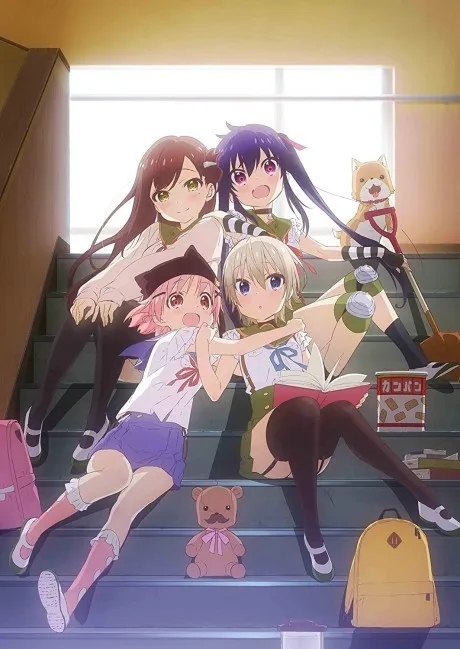
The marketing for this show was dirty in the best way possible. Promotional art showed four girls and a dog doing cute poses. The title School-Live! sounds like Love Live! or any other school club anime. The Wikipedia page lists it as horror and slice of life which sounds like a contradiction until you watch it. Studio Lerche knew exactly what they were doing. They wanted you to think this was healing comfort food before revealing it was poison.
Episode one follows Yuki through a normal school day. She talks to classmates who aren't there. She sees a clean classroom that is actually trashed. The camera stays in her perspective so you see her delusion first. Other club members look stressed or annoyed but you don't know why yet. There is a weird barricade in the hallway that Yuki ignores. Then the ending scene happens and the show switches to Miki's point of view. You see Yuki talking to empty chairs in a destroyed room. The music stops. The color palette shifts to gray and brown. You realize you have been tricked. The club isn't living at school for fun. They are trapped there because the city is overrun with zombies they call "them."
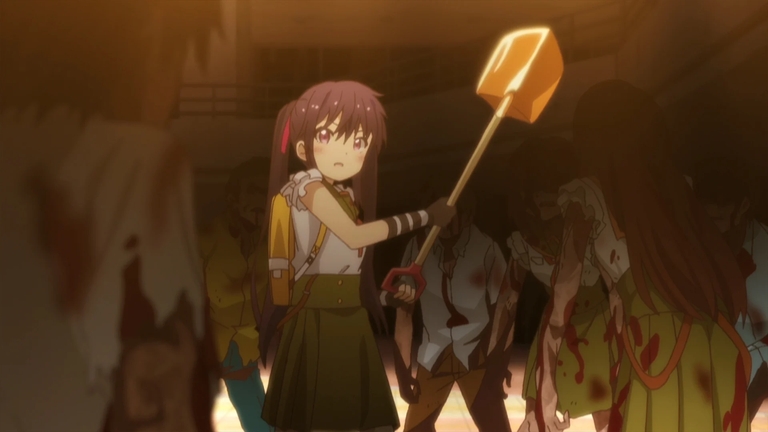
This isn't just a twist for shock value. The entire series runs on this dual perspective. Yuki sees a school festival. The others see a supply run through zombie-infested corridors. Yuki sees a fun camping trip on the roof. The others see desperate rationing while surrounded by the infected. The show cuts between these two realities constantly. One minute you get sparkles and friendship speeches. The next you get blood and the sound of a shovel crushing skulls.
Yuki's Broken Mind
Yuki Takeya is the main character and she is completely delusional. This isn't a spoiler. It is the central mechanic of the show. She suffered a complete psychological break when the outbreak happened and her brain walled off the trauma. She lives in a fantasy where the apocalypse never occurred and her favorite teacher Megumi Sakura is still alive. The psychological analysis of her condition shows she uses the School Living Club rules as a framework to maintain her sanity. As long as she follows the club activities, her brain stays protected.
The other girls know she is broken. They don't try to fix her. They play along because Yuki's delusions give them structure. When Yuki wants to have a sports festival, they use it as cover to scout for supplies. When Yuki wants to have a test of courage, they use it to check the barricades. Her mental illness becomes a survival tool. She keeps their days organized. She gives them a reason to keep the school clean and maintained. Without her fantasy, they would just be four girls waiting to die in a concrete box.
Megu-nee is the biggest manifestation of this. Yuki sees her teacher walking around giving advice and scolding her. In reality, Megumi died early in the outbreak. She got infected trying to save the students and the girls had to kill her. Yuki's brain couldn't handle that guilt so it resurrected Megu-nee as a hallucination. The other girls see Yuki talking to empty air but they never correct her. They even set a place at the table for the imaginary teacher. It is messed up and sweet at the same time.
The Club Members Who Keep the Lie Alive
Yuuri Wakasa is the club president but she functions as the mom of the group. She cooks the meals, manages the supplies, and makes the hard choices. She is also falling apart mentally but hides it better than Yuki. She wears the leader mask so the others don't panic. Kurumi Ebisuzawa is the fighter. She carries a shovel everywhere because she used it to kill her infected crush early in the outbreak. She does the dangerous work like clearing zombies from the halls and fixing the barricades. She is aggressive and practical but the violence is eating her alive. The cast dynamics show how each girl fills a specific survival role.
Miki Naoki is the late addition. She was trapped in a shopping mall during the initial outbreak and watched her best friend Kei leave the safety room out of boredom. Miki got rescued by the club during one of Yuki's "field trips" and she initially hates the delusion act. She thinks they should force Yuki to face reality. Over time she realizes that reality is too awful and Yuki's fantasy is the only thing keeping them from eating a bullet. Miki becomes the voice of reason but also the one who understands that reason doesn't matter anymore.
The Dog That Broke Everyone's Heart
Taroumaru is the club dog and the anime treats him way different than the manga. In the original comics he was a minor character who got infected immediately and had to be abandoned. The anime by Lerche expanded his role massively. He becomes a full member of the group. He plays with the girls. He alerts them to danger. He has personality and quirks. This makes what happens later hurt so much worse.
Taroumaru gets infected by a zombified Megu-nee who is wandering the basement. The girls find a vaccine that works on Kurumi when she gets bitten later, but Taroumaru dies from the injuries after fighting the infection. He dies in Miki's arms remembering who she is. It is brutal. The anime uses this to show that even the small joys get taken away in this world. The manga didn't spend enough time with the dog for you to care. The anime fixates on him so his death feels like losing a main character. It is cheap emotional manipulation but it works.
When the School Falls Apart
Episode ten is where everything goes to hell. The zombies break through the barricades. The school is no longer safe. Kurumi gets bitten by the zombified Megu-nee during a fight in the basement. Yuuri starts hallucinating that a teddy bear is her dead little sister Ruu and refuses to acknowledge reality. The sanctuary crumbles. The horror elements ramp up here because the illusion can't be maintained anymore.
The group has to "graduate" from the school. This means leaving the only safe place they know and walking through zombie-infested streets to find a new home. The final episodes show them traveling to St. Isidore University where other survivors are supposedly holding out. The anime ends with them leaving the school behind which is different from the manga that continues the story much further.
The University Arc and What It Means
St. Isidore University introduces new characters and new conflicts. There are two factions there. The Circle is a group of students who cooperate and share resources. The Militants are violent survivalists who follow a guy named Takahito. He runs body checks and kills anyone who might be infected. There is also a scientist named Aosoi who knows the outbreak was caused by the Randall Corporation releasing a bioweapon called Omega.
The anime only hints at this stuff because it ends after twelve episodes. The manga continues with Kurumi slowly turning into a zombie despite the vaccine keeping her mostly human. The girls find out the Randall Corporation set up Megurigaoka City as a test site. The school had emergency supplies and solar power because it was meant to be a shelter for observing the outbreak. This conspiracy stuff gets complicated with secret bunkers and radio broadcasts from other survivors.
Yuuri's delusion about Ruu, the teddy bear, becomes a major plot point here. She treats the stuffed animal like her actual sister and the other girls play along just like they did with Yuki. It shows that Yuki isn't the only broken one. They are all traumatized and using fantasy to cope. The Militants represent what happens when you lose all fantasy and become pure survival instinct. They are cruel and paranoid. The Circle represents keeping your humanity through community. The anime doesn't get deep into this but the setup is there.
Why the Anime Changed the Manga
The anime adaptation covers roughly the first four volumes of the manga but switches the order of events and adds original scenes. The Taroumaru stuff is the biggest change. The manga has the dog die off-panel basically. The anime makes it a major tragedy. The anime also ends with the girls leaving the school on a hopeful note while the manga continues with much darker material including Kurumi's body temperature dropping and her acting more like a zombie over time.
Some fans hate the anime ending because it feels rushed. The manga goes on for twelve volumes and has a sequel called School-Live! Letters or Gakkougurashi! Otayori that shows the characters years later. In that sequel Yuki becomes a teacher at a rebuilt school. The anime only gives you the beginning of the story. It is a solid stopping point but it leaves a lot of threads hanging.
The Real Horror Is Coping
The zombies in this show are background noise. The real horror is watching four teenage girls try to maintain their sanity while the world ends. Yuki's psychosis isn't portrayed as something to fix. It is portrayed as a valid survival strategy. The show argues that living is different from surviving. The Militants survive by any means necessary but they aren't living. Yuki and her friends live by pretending the world is still normal even when they are scooping supplies out of a dead convenience store clerk's hands.
The psychological themes tie into Japanese work culture and the pressure to maintain a happy face even when everything is terrible. The moe aesthetic isn't just bait. It represents the fantasy the characters cling to. When the art gets dark and sketchy, that is reality breaking through. The contrast is the whole point. You need the bright colors to feel the darkness when it comes.
The show also deals with survivor's guilt. Miki watched her friend leave a safe room and probably die. Kurumi killed her crush. Yuuri failed to protect her actual little sister before the show started. They all carry weight. The School Living Club is group therapy disguised as a club activity. They cook meals together not because they are hungry but because it feels normal. They sleep in the classroom because beds feel too luxurious for the end of the world.

Why This Show Still Matters
Most zombie media focuses on action and gore. School-Live! focuses on the boring parts of the apocalypse. The waiting. The rationing. The pretending. It asks what you would do if you had to keep going to school while zombies moaned outside the window. The answer it gives is that you would probably go crazy. But you might go crazy together with your friends and that makes it bearable.
The anime is a solid introduction to the story even if it doesn't finish it. The animation holds up despite some cheap moments early on. The voice acting for Yuki is perfect because she sounds genuinely happy even when describing horrible things. The opening song Friend Shitai sounds like a generic cute anime intro but the lyrics are about wanting to die together with your friends rather than alone. Everything in this show has two meanings.
School-Live! anime explained comes down to this. It is a story about trauma and the lies we tell ourselves to survive. Yuki isn't stupid. She is protecting herself. The other girls aren't enabling her. They are using her delusion as a shield for all of them. When the anime ends with them walking into the unknown, you don't know if they will make it. But you know they will keep pretending they are just going on another school trip. That delusion is the only weapon they have left.
Summary
School-Live! is a 2015 horror anime that disguises itself as a slice-of-life comedy until revealing a zombie apocalypse setting. It follows Yuki Takeya, a girl whose trauma-induced psychosis makes her see the ruined school as pristine and populated, while her friends maintain the illusion to preserve their sanity. The series explores themes of mental health, survival versus living, and the coping mechanisms used by trauma survivors. Through its contrasting art styles and unreliable narration, it delivers a unique take on the zombie genre that prioritizes psychological depth over action, following the School Living Club as they navigate the collapse of society from within their former high school sanctuary.