
People keep calling Shogo Makishima a nihilist but they don't get it. Shogo Makishima and the philosophy of Psycho-Pass isn't about destroying meaning, it's about forcing humanity to wake up from a coma where everyone thinks they're safe but they're actually just sedated. The guy reads too many books and kills people with razors while quoting Shakespeare, sure, but he's not just some edgy villain who wants to watch the world burn. He's the only one in the entire show who sees the Sibyl System for what it really is: a cage that pretends to be a safety net, and he's the only one who can't be measured by the system's broken tools.
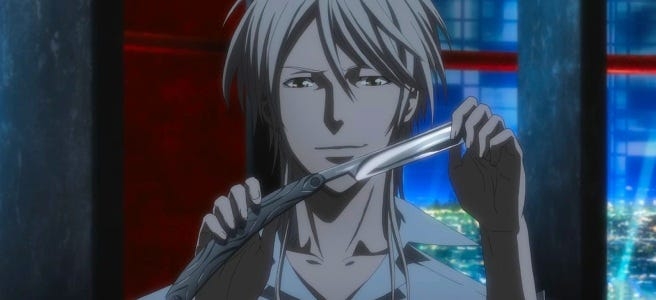
He can't be scanned by the Dominators because he's criminally asymptomatic. That means his brain doesn't process murder as stress or trauma. To him, slitting a throat feels the same as peeling an apple or turning a page in a book. That's not evil in the traditional sense. That's a completely different operating system running in a human body, one that lets him see the cracks in the Sibyl System's logic without flinching while everyone else is too busy being afraid of their own crime coefficients turning cloudy.
Most viewers write him off as a crazy anarchist who just hates rules. They're wrong and it annoys me. Makishima doesn't want chaos for chaos's sake. He wants people to think for themselves again, to feel the weight of their own choices crushing down on them until they realize they're alive. He thinks a world where you can't choose to be bad is just as fake as a world where you can't choose to be good, and he thinks that a society that removes danger removes everything that makes us human.
Why Being Criminally Asymptomatic Is Basically a Superpower
The Sibyl System scans everyone's brain to see if they're stressed or angry or thinking violent thoughts. If your number gets too high, the cops kill you or lock you up in a facility where they turn you into an Enforcer or just let you rot. It's a stupid and broken way to run a society but it works on almost everyone because most people feel guilt and fear. Except Makishima. His crime coefficient stays low no matter what he does. He could massacre a room full of people and the Dominator would still read him as a non-threat with a clear psycho-pass.
This isn't just a plot device to make him hard to catch. It's the core of his entire philosophy and the reason he exists outside the system completely. Because he doesn't feel guilt or fear or stress about violence, he can look at the Sibyl System objectively without his own brain chemicals betraying him. Everyone else is either terrified of being labeled a latent criminal or so brainwashed they can't imagine living without the system's protection. Makishima sees the strings pulling the puppets. He sees that Sibyl isn't a god, it's just a bunch of psychopathic brains in jars pretending to be objective while they play favorites with who gets to live.
This Reddit breakdown gets into how this makes him an outcast from the moment he's born. The system literally can't see him, which forces him to exist in a blind spot, invisible to the all-seeing eyes that govern every aspect of Japanese society. He doesn't get the comfort of being judged by the machine. He has to judge himself. That's heavy stuff for an anime villain, and it explains why he quotes philosophy instead of just laughing maniacally like a cartoon bad guy.
The Books Makishima Actually Reads and Why They Matter
He quotes George Orwell's 1984 like it's scripture and carries around Joseph Conrad's Heart of Darkness like a manual. He references Shakespeare's Titus Andronicus when he's helping Rikako Oryo murder her classmates and mutilate their bodies. This isn't just showing off how well-read he is or making him look smart for the audience. Each book represents a specific failure of the system he's fighting, and he uses them like roadmaps for how to break people out of their complacency.
Orwell wrote about totalitarian control and the destruction of language to limit thought so people can't even conceive of rebellion. That's exactly what the Sibyl System does when it decides who's worth keeping alive based on stress levels, reducing human existence to a color-coded number. Conrad wrote about the darkness inside civilized men when you strip away the rules of society, showing that the horror comes from realizing we're not as civilized as we think. Makishima thinks that darkness is necessary, that without the capacity for violence and evil you're not human, you're just livestock being kept docile until slaughter.
Wikipedia lists his favorite authors as Nietzsche, Foucault, and the Marquis de Sade. He's into the heavy hitters who questioned whether morality is real or just a tool the powerful use to control the weak, and he applies their ideas literally. When he quotes the parable of the sower before he dies, he's comparing himself to the seed that falls on good ground, believing his death will inspire others to reject the system even if he won't live to see it.

Nietzsche and the Problem of the Herd
Makishima is basically what happens if you take Nietzsche's Ubermensch concept and give him a Pencak Silat black belt and a bunch of sharp objects and then tell him that society is run by a computer made of brains. Nietzsche said that modern society creates "herd morality" where everyone is kept docile and weak so they don't threaten the status quo or make the comfortable people uncomfortable. Sound familiar? That's the Sibyl System in a nutshell, keeping everyone beige and calm and harmless.
CBR's breakdown of the real philosophies points out that Makishima follows Nietzsche's idea of going "beyond good and evil." He doesn't accept that Sibyl's definitions of right and wrong are legitimate just because they have guns and cameras. He thinks true morality requires the freedom to choose, even if you choose to do terrible things, because a choice made under duress isn't a choice at all, it's just survival. The show tries to make him look like a monster for this philosophy by showing him cutting that woman's throat in episode 11 while smiling, but from his perspective he's proving a point about the system's blindness.
The Dominator won't activate on him because his numbers are good even while he's murdering someone. That's the ultimate proof that the system is broken, that it can't recognize real evil or real good, it can only recognize stress hormones and brain waves. Makishima thinks that's hilarious and pathetic, that humanity has outsourced its moral judgment to a machine that can't even tell when it's being mocked.
Why He Would Rather Die Than Become a Brain in a Jar
At the end of season one, Sibyl offers him everything a villain could want. They want him to join them, to become one of the brains that runs the system, to live forever in a vat of fluid hooked up to the network. He'd get immortality. He'd get power. He'd get to shape society forever according to his will. He says no and runs away, and people think this is crazy but it makes perfect sense if you understand that he believes in amor fati, the love of fate.
Makishima believes that being human means accepting that you're going to die, that finitude is what gives life meaning. The Sibyl System offers "false immortality" by letting brains live forever in vats, cheating death by becoming part of a collective monstrosity. To him, that's disgusting and cowardly. It's refusing to play the game of life by the rules, trying to win by breaking the board. He'd rather die in a field of oats at Kogami's hands than live forever as a cog in the machine he hates, because at least as a corpse he's still himself.
This analysis explains how he views joining Sibyl as the ultimate surrender, worse than death. His final words about paradise aren't about heaven or the afterlife. They're about the relief of finally being free from a system that wants to own him, process him, and digest him into their collective even after death. He dies free while the Sibyl brains live forever in chains.
The Kogami Obsession and What It Means
Makishima doesn't care about most people. He uses them as tools or kills them when they bore him, viewing most of humanity as sheep who deserve their shepherd. But he fixates on Shinya Kogami like a predator who finally found prey that might actually be dangerous enough to be interesting. He leaves clues specifically for Kogami. He kills Kogami's friend Sasayama in the most brutal way possible, plastinating the body and arranging it like art, specifically to wake Kogami up from his dog-like loyalty to the system.
They share this weird mutual recognition that borders on respect. Kogami is the only one hunting Makishima who actually understands what Makishima is saying about freedom and will. Everyone else is just following orders or trying to maintain the status quo. Kogami is acting on pure will and personal vendetta, breaking the law to get revenge. That's why Makishima is almost happy when Kogami finally kills him. He wanted to die by the hand of someone who had the will to kill, not the system that just executes code based on numbers.
The Illinois academic paper on the Romantic Sublime talks about how Makishima represents self-knowledge through confrontation with the terrifying. Kogami represents that confrontation for him. When they fight in the oat field, it's not just a battle between cop and criminal. It's two men affirming each other's existence through violence, proving they're real. Kogami proves he has free will by breaking the law to kill Makishima. Makishima proves he was right about human nature by forcing Kogami to become a killer instead of a cog.
Kantian Ethics vs Real Freedom
Akane Tsunemori represents the opposite philosophy from Makishima. She's all about Kantian duty ethics and the categorical imperative, believing you should act in a way you'd want everyone to act, following rules because they're rational and universal. She won't kill Makishima even when she has the chance because that would make her a murderer too and she believes the system can be fixed from within by good people following the rules.
Makishima thinks that's adorable but useless, like trying to empty the ocean with a bucket. He believes that true freedom means accepting that people will make bad choices and that's okay because the alternative is no choice at all. Kant's ethics require everyone to be rational actors but Makishima knows humans are messy, emotional, violent, and irrational. The Sibyl System tries to enforce Kantian rationality through technology and it creates a dystopia where no one is really alive, they're just maintaining homeostasis.
When Akane tries to arrest him instead of shooting him, he tests her by giving her a shotgun and daring her to use it. She won't because she's still trapped in the system's logic, unable to break free even when she knows it's wrong. He respects her consistency but he pities her lack of courage to step outside the lines.
The Razor and the Tomatoes
Little details about Makishima tell you everything about his philosophy. He keeps a straight razor as a treasured object, not just as a weapon. He uses it to kill up close, to feel the physical reality of what he's doing, to experience the moment. He doesn't use guns from a distance because that separates you from the act, making it abstract and clean. He wants to feel the blood, to smell it, to experience the qualia of murder in full sensory detail.
He also loves eating tomatoes. Just plain tomatoes, raw and simple. It's this weird domestic detail that humanizes him and shows he isn't a cartoon villain who lives in darkness surrounded by death. While he's orchestrating mass murder and bioterrorism, he's snacking on fresh vegetables and enjoying the texture. It shows that he enjoys simple physical pleasures and is fully present in his body. He's not dissociated or dead inside. He's hyper-alive.
This connects to his belief in qualia, the subjective experience of being conscious that can't be measured or quantified. The Sibyl System reduces human experience to numbers and colors and crime coefficients. Makishima thinks the "splendor of souls" is in the sensory details, in the things you can't measure like how a tomato tastes or how a book feels heavy in your hands or how rain smells. The system can't quantify that, so it doesn't matter to Sibyl, which is why Makishima hates it.
The Helmet Revolution and Social Control
One of Makishima's weirdest and most effective plots involves the helmets that copy other people's crime coefficients. He helps a mechanic distribute these helmets that make criminals invisible to the system by borrowing the psycho-pass readings of innocent bystanders nearby. It causes chaos in the streets as people realize they can act without being punished, and the police can't stop them because their weapons won't activate.
This isn't just terrorism for fun. It's a demonstration, a proof of concept. He's proving that the only thing keeping society orderly is the threat of violence from the Dominators. Once people realize they can act without being punished, they immediately start looting and killing and burning because the "peace" was never real. It was just fear wearing a mask.
He finds this both hilarious and depressing. It proves that humans are naturally violent and free, not peaceful and controlled. The system hasn't changed human nature, it's just suppressed it under a lid like a pressure cooker. When the pressure is released, people explode into their true selves. That's why he thinks the system is doomed to fail eventually and why he's trying to speed up the collapse.
Why He Didn't Kill Akane When He Had the Chance
People get confused about this and think it's a plot hole. He shoots Akane's friend Yuki right in front of her to traumatize her and break her worldview, but later when he has a perfect chance to kill Akane herself, he doesn't take it. Some fans think this is just plot armor to keep the protagonist alive but it's actually completely consistent with his philosophy about choice and will.
He doesn't kill Akane because at that point she hasn't chosen to be his enemy yet. She's just doing her job, following orders, being a good little inspector. He wants her to break free of the system and choose to hunt him down personally, acting on her own will rather than her duty. He wants her to become like Kogami. Killing her while she's still just a cog in the machine wouldn't prove anything about human freedom. It would just be eliminating another drone.
He respects her potential to become free. He sees that she could be something real if she just stopped following the rules and started making her own choices. That's more interesting to him than another corpse, and it fits his pattern of testing people's wills to see if they're really alive or just sleepwalking.

Psychopath or Philosopher
Here's the big question everyone argues about in forums and nobody agrees on. Is Makishima a philosopher who truly believes in freedom and is willing to die for his convictions, or is he just a psychopath using philosophy to justify hurting people because he enjoys it? The show leaves it ambiguous on purpose because the answer is probably both at the same time.
He does seem to genuinely value human freedom. He risks his life to destroy the system. He could have joined Sibyl and lived forever but he chose death instead because he believed in his principles. That suggests real conviction, not just empty words. But he also seems to enjoy suffering too much, smiling when people die and arranging murders like art projects that reference his favorite books.
I think he's both. He's a criminally asymptomatic individual which means he literally cannot feel empathy the way normal people do, so he doesn't feel bad about the deaths he causes. But he's also smart enough to understand what he's missing and to value the concept of humanity even if he can't feel it emotionally. He's like a colorblind person who understands the importance of rainbows intellectually and wants everyone else to appreciate them even if he can't see the colors himself.
The Final Scene in the Oat Field
When Kogami finally catches him in that field of oats, Makishima isn't scared or angry. He's satisfied and almost peaceful. He quotes the Bible about the sower and the seeds falling on different grounds, accepting that he's going to die. He's okay with it because he died on his own terms, not the system's terms, and he died by the hand of someone who understood him.
Kogami uses a mechanical gun, not a Dominator. This matters more than people realize. The Dominator represents the system's judgment, automated and clean. Kogami using a regular gun represents human judgment, messy and personal and full of hate and will. Makishima accepts this death because it's real. It's not an algorithm executing code. It's one human being choosing to kill another because he wants to, because he decides it's right, not because a computer told him to.
The Psycho-Pass Wiki notes that he practices Pencak Silat and sleeps only three hours a night, always living on the edge. His death is the final act of a life lived at full intensity, refusing to fade into the safe mediocrity that the Sibyl System offers. He dies in the sun in a field of grain, human and free, while the Sibyl brains rot in their vats forever.
What We Can Learn From a Villain
I'm not saying Makishima is right or that murdering people to prove a point is justified. That's obviously messed up and he's a killer who ruins innocent lives. But his critique of the Sibyl System is solid and uncomfortable. Any society that removes choice to ensure safety isn't really free. Any system that decides who gets to live based on stress levels is going to create monsters like him by excluding everyone who doesn't fit the mold.
Shogo Makishima and the philosophy of Psycho-Pass asks us whether we'd rather be safe or free, and it suggests that most people choose safety because they're scared of the responsibility that comes with freedom. Makishima chose freedom and it killed him. But at least he got to choose, and at least he lived as a full human being rather than a managed resource.
The show wants you to think the Sibyl System is necessary but broken. Makishima wants you to think it's unnecessary and evil and should be destroyed. The truth is probably somewhere in the middle, but Makishima makes the stronger case because he lives his philosophy while everyone else just talks about it. Safety without freedom is just a prison with good lighting and nice furniture.
Next time you watch Psycho-Pass, don't just root for Akane to catch the bad guy. Ask yourself if you'd have the guts to throw away your books and rally in the streets like Makishima's favorite quote says. Most of us wouldn't. We'd keep our heads down and hope our psycho-passes stay clear. That's exactly what he's talking about when he calls us sheep.