
Steins Gate 0 Okabe Rintarou character study and emotional arc hits different because it isn't about saving the day. It's about failing so hard you break into pieces and having to live with the shards. When you finish the original Steins Gate, you remember Hououin Kyouma screaming about being a mad scientist and conquering time itself. Then you load up Steins Gate 0 and find the same guy staring at a wall in a black suit, popping pills to stop his hands from shaking because he watched Makise Kurisu die and knows it's his fault. That whiplash is the point. This isn't a sequel where the hero gets stronger. It's the story of the version of Okabe who gave up, and why that failure matters more than any victory.
This version of Okabe isn't the hero who figures everything out. He's the guy who gets left behind in the Beta world line after accidentally killing Kurisu himself. He gives up on time travel. He throws away the lab coat. He tries to be a normal college student while the world marches toward World War 3 and his friends look at him like he's supposed to fix it. He can't. He won't. And watching him dig out of that hole requires understanding exactly how deep he buried himself. The depression isn't a plot device. It's a prison he builds because he thinks he deserves it.
The Death Of Hououin Kyouma
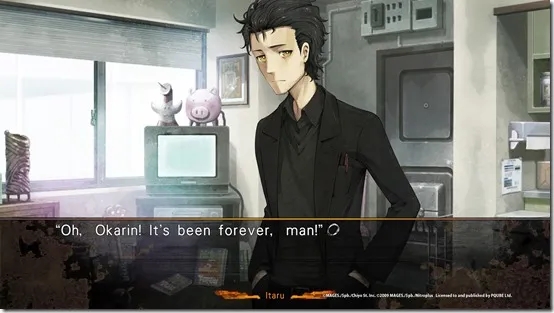
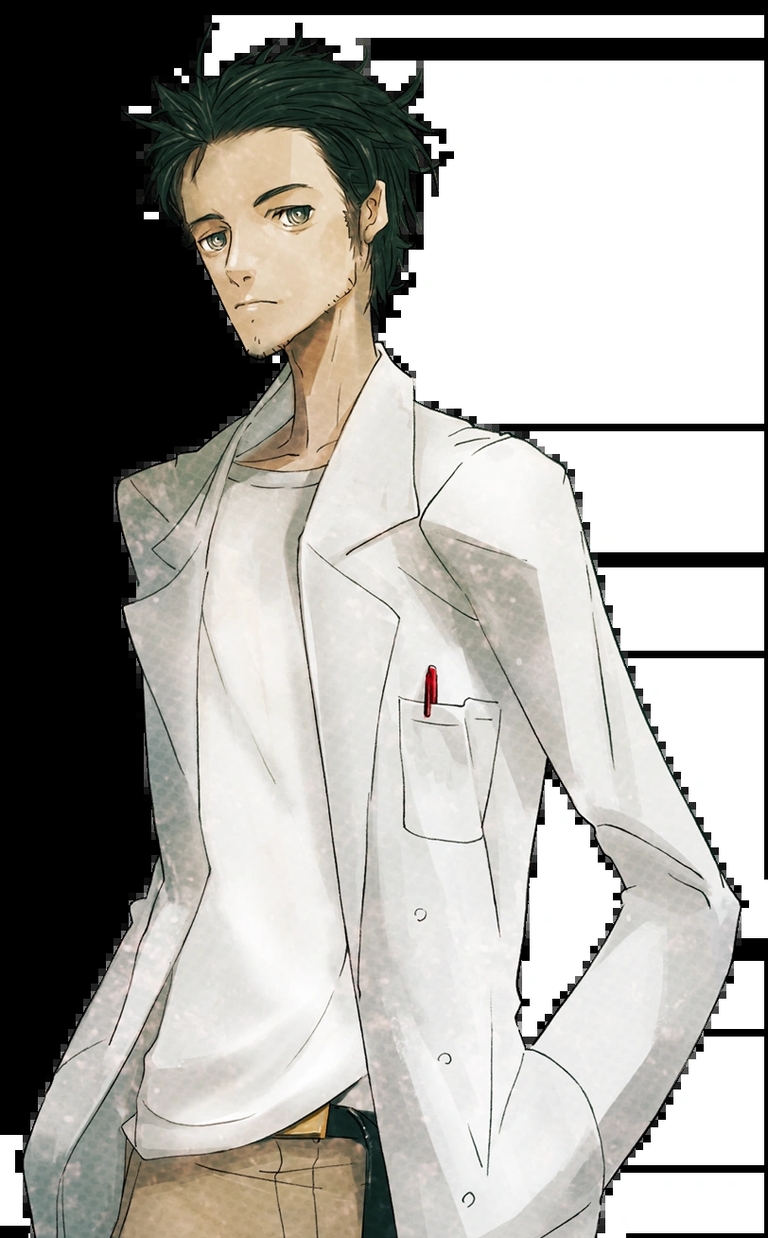
The first thing you notice is the clothes. In the original series, Okabe wore that white lab coat everywhere. It was his armor. It let him be Hououin Kyouma, the insane mad scientist who could laugh at danger and talk to himself on the phone like the Organization was watching. That persona wasn't just a joke. He built it to protect Mayuri when they were kids, to give her something silly to laugh at so she wouldn't disappear into her own grief after her grandmother died. It worked for years. It carried him through the Alpha world line where Mayuri kept dying and he kept time leaping until he could save her. The persona was a shield against reality.
Then he got to the Beta world line. He saw Kurisu dead in a pool of blood. He tried to fix it and ended up stabbing her himself. That one mistake broke the logic of his entire life. If the mad scientist persona was supposed to save people, and he used it to kill the woman he loved, then the persona is garbage. So he throws it away. You see him in Steins Gate 0 wearing black suits and dress shirts. He looks like a funeral director. He acts like a ghost walking around Tokyo Denki University, avoiding the Future Gadget Lab and flinching every time someone mentions time travel. His hair is flatter. His eyes are empty.
This isn't just sadness. It's full dissociation. He goes to therapy sessions where he sits silently. He takes medication for anxiety and depression. When Suzuha shows up from the future begging him to try again to save Kurisu and prevent WW3, he tells her no. He tells her he's done. He watched Mayuri die hundreds of times in the Alpha line and kept going because he had to. But watching Kurisu die once by his own hand? That stopped him cold. The guilt is different when you're the murder weapon. The Alpha trauma was about helplessness. The Beta trauma is about responsibility.
The Amadeus Trap And Digital Ghosts
Things get worse when Maho Hiyajo drags him into the Amadeus project. They have built an AI from Kurisu's memories stored before she died. It talks like her. It argues like him. It remembers the conversations they had in the Alpha world line that this Okabe never technically experienced but feels in his bones because of Reading Steiner. Interacting with Amadeus Kurisu is pure psychological poison for this broken man.
He knows she's dead. He held her body. But here's a voice on a phone that sounds exactly like her, teasing him about being a chuunibyou loser and asking why he looks so tired. Every conversation rips the scab off the wound. Some fans think he's stupid for talking to the AI, but they miss the point. He's addicted to the pain because he thinks he deserves it. He failed to save the real Kurisu, so he punishes himself by visiting this digital ghost who reminds him what he lost. It's self harm disguised as curiosity. He can't let go because he thinks letting go means betraying her.
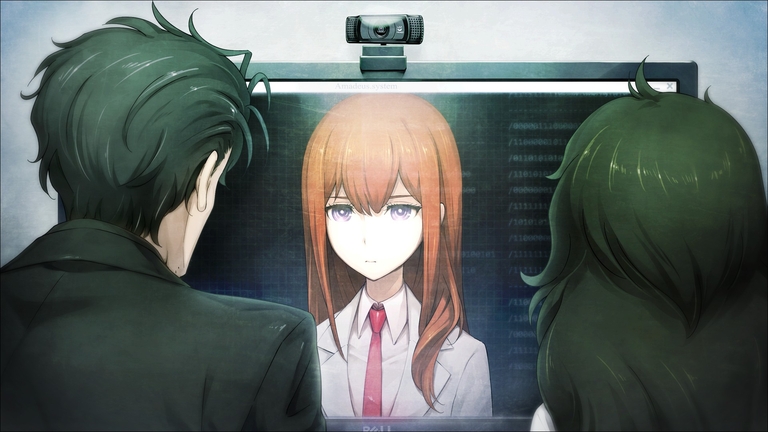
Maho complicates this because she's tiny and brilliant and has a massive inferiority complex about Kurisu. She looks at Okabe and sees a guy who knew the Kurisu that wasn't perfect, the one who talked about fate and time machines instead of just neuroscience. Their friendship is messy and codependent. Maho wants to prove she's as good as Kurisu was. Okabe wants to forget Kurisu existed but can't because Maho keeps bringing her up. They're terrible for each other and exactly what the other needs. When Maho gets captured or shot in various routes, Okabe moves. Not because he's Hououin Kyouma again, but because he cannot watch another person die because of him.
The AI also raises messed up questions about what makes a person real. If Amadeus Kurisu remembers everything and acts the same, is she Kurisu? Okabe knows the answer is no, but he plays along because it's the only way to hear her voice. This keeps him stuck in 2010 while the world burns around him. He's so busy talking to a ghost that he ignores the living people telling him he can still fix things.
The Refusal And The Weight Of Worlds
People call this Okabe selfish. They say he should have helped Suzuha immediately when she told him about WW3. They miss that he's disabled by PTSD. His brain chemistry is fried. He isn't choosing to be useless; he's traumatized. The visual novel shows him having full panic attacks, hyperventilating, needing Mayuri to hold him like a child. This is real mental illness portrayed without glamour. When he sees a time machine or hears the words "time leap," he flashes back to stabbing Kurisu. His body shuts down.
Suzuha doesn't get it at first. She's from a future where the war already happened and she sees Okabe as the legend who could fix it. She gets angry when he refuses. She calls him a coward. She even shoots him in some routes to stop him from interfering with her plan. But Daru understands. Daru watches his best friend falling apart and knows pushing won't help. He tries to be patient. He tries to be a good dad to Suzuha while also respecting that Okabe is broken. It's a tightrope walk that shows how much Daru has grown from the pervy hacker in the original series.
Mayuri is the one who suffers silently. She knows Okabe is hurting but he won't tell her why. He keeps her at arm's length to protect her, which just makes her feel useless. In Steins Gate 0, Mayuri gets agency. She adopts Kagari. She runs the cafe. She eventually takes matters into her own hands and gets in the time machine with Suzuha because she realizes Okabe won't save himself. She leaves him behind to force him to act. It's brutal and necessary.
The 3000 Time Leaps And Future Despair
The real horror show happens when you learn what Beta Okabe does in 2036. After getting captured and tortured by Stratfor or DURPA depending on the route, he ends up in a dystopian future where WW3 already happened. The world is ashes. Mayuri died years ago. Daru is fighting a resistance war and got old and thin. Suzuha is a soldier carrying the weight of the failed mission. And Okabe? He finds a time leap machine and uses it over 3000 times to jump back from 2036 to 2011.
Think about that number. In the original series, he jumped maybe a few dozen times to save Mayuri and it nearly destroyed his mind. Made him cynical and cold. This guy does it thousands of times. He lives the same years over and over, watching his friends age and die, trying to find the one thread that leads to the Steins Gate world line. He becomes a husk. A walking corpse with perfect memory of every failure. His body deteriorates. His mind fractures. By the time he records that video message for his past self, the one that says "deceive the world," he has lived decades of subjective time in pure hell.
This is the Steins Gate 0 Okabe Rintarou character study and emotional arc at its core. It's not about the cool time travel tricks. It's about a man so stubborn that even when he gives up, he keeps fighting in the background until he becomes the thing he feared. He turns into the crazy old man sending messages to the past, exactly like the conspiracy theories he used to joke about. He's no longer the protagonist of his own story. He's the setup for someone else's victory.
The Return And Putting The Coat Back On
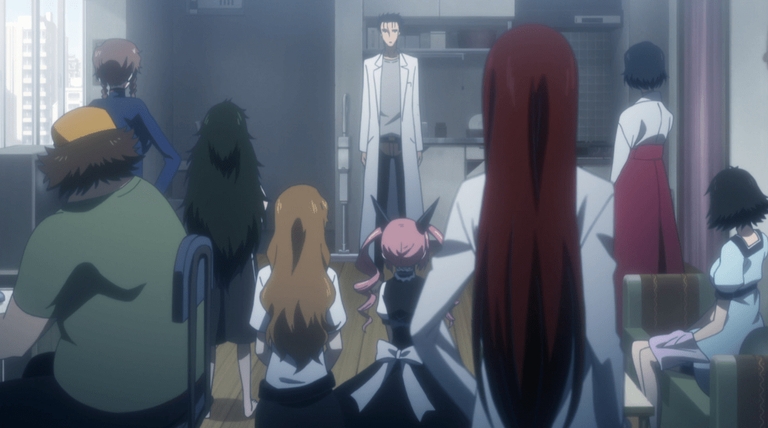
Eventually, he snaps out of it. Episode 20 of the anime, Rinascimento of the Unwavering Promise, shows old Daru and old Maho rebooting a broken future Okabe's brain using memories from a failed time leap attempt stored as data. They basically restore a backup of his mind from before he went completely insane. He wakes up in 2036, frail and used up, but with the fire back in his eyes. He puts the lab coat back on. Not the black suit. The white coat. He becomes Hououin Kyouma again, but different. He isn't playing anymore. He knows exactly how much it costs to save someone.
The Okabe Rintarou path in Steins Gate 0 is unique because he fails upward. Every mistake teaches him something he needs for the final solution. When he saves Mayuri and Suzuha in the past, he creates the loop that allows the 2010 Okabe to receive the video message. Without this broken man's suffering, the true ending of the original Steins Gate is impossible. That is why Steins Gate 0 is not a sequel but the missing piece. It's the backstory for the happy ending. The pain is the point.
His first act after returning is preventing the missile strike that kills Mayuri and Suzuha in the time machine. Then he realizes they're lost in time because the machine ran out of fuel. So he takes the prototype C-193 time machine and jumps to 18000 BC to find them. He knows he's probably going to die there. He knows the world line might get erased anyway. He doesn't care. He caused this mess by refusing to help earlier. Now he fixes it.
The 18000 BC Sacrifice
The mission to 18000 BC is the culmination of his arc. He's not trying to save Kurisu anymore. He's accepted she's gone. He's trying to save Mayuri, the girl he started all this to protect in the first place. He's coming full circle. The Okabe who left Mayuri behind in 2010 because he was too broken to move is now the Okabe who will strand himself in the prehistoric era to ensure she gets home.
He finds them in the Time Machine buried in ice or rock depending on the interpretation. He gives them the fuel they need. He sends them back to 2025. And he stays behind. Or he gets in his own machine and vanishes into the time stream. The anime and VN have slightly different interpretations of exactly what happens to him, but the result is the same. He doesn't get to see the Steins Gate world line. He buys the ticket for someone else.
This is the opposite of a power fantasy. It's a story about accepting that you won't be the hero at the end. The Beta Okabe is the failed draft that makes the final version possible. His depression, his refusal, his 3000 leaps, his death in the past, all of it is necessary. Without him, the Operation Skuld video doesn't exist. Without that video, the 2010 Okabe doesn't get the idea to fake Kurisu's death using a metal Upa and blood packs.
Why The Sad Scientist Matters More Than The Mad One
When people rank anime protagonists, they usually pick the winners. The guys who never give up and punch through obstacles. But Steins Gate 0 argues that the broken man who gives up and then crawls back anyway is just as important. This Okabe shows that strength isn't about never falling down. It's about staying down for fifteen years, losing your mind, and still dragging yourself up to do the right thing when it matters.
The original Okabe time leaped like it was a video game mechanic. He had save states. He could retry. This Okabe knows that every shift erases a world full of people. He feels the weight of Reading Steiner as a curse, not a superpower. He remembers every dead timeline while everyone else forgets. That is why he's the Sad Scientist. He carries all the graves in his head. He remembers the versions of his friends who died screaming.
The anime gets flak for being slower than the original. That's the point. Depression is slow. Recovery is slow. You don't just flip a switch and become a hero again. You crawl through broken glass for years, lose your mind in 2036, record a video for your younger self, and maybe, maybe, you buy him a chance to succeed where you failed. That's not bad writing. That's what sacrifice looks like when it's ugly.
The Loop Closes
Steins Gate 0 Okabe Rintarou character study and emotional arc ends not with him getting the girl, but with him accepting he won't. He records the message. He saves Mayuri and Suzuha in 18000 BC. He stays behind or disappears into the time stream. He becomes a martyr for a world line he will never see. That is the opposite of the original's triumph, and that is why it's beautiful. It shows that sometimes the hero isn't the one who wins. Sometimes the hero is the one who loses so completely, so thoroughly, that he creates the space for someone else to win instead.
This version of Okabe proves that you don't have to be strong to be important. You just have to keep going even when you're broken. The mad scientist died in Beta. The sad scientist finished the job. And because he did, the Steins Gate world line exists where everyone can live. He never sees it. But he makes it real.