
Yuki Takeya's character arc in School-Live! isn't about becoming a better fighter or learning to shoot a gun. It's about learning how to wake up without dying. When you first watch this show, you think you're clicking on another fluffy slice-of-life anime where girls drink tea and plan festivals. The opening is bright. The colors are soft. Yuki runs down the hallway with a backpack that has little wings on it, grinning like an idiot about how much she loves school. Then the last thirty seconds of episode one hit, and you realize the school is a ruin, the students are zombies, and Yuki is seeing things that aren't there. She's not having fun. She's surviving.
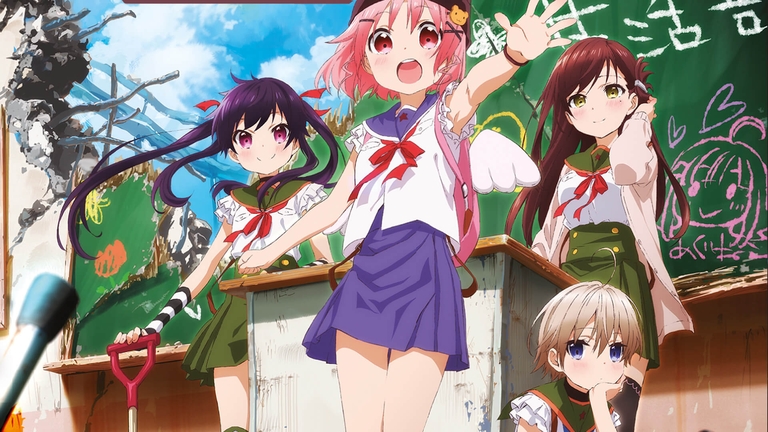
The thing that makes Yuki's arc work is that her mental break isn't treated like a problem the other characters need to fix immediately. In fact, they protect it. They play along with her fantasy that they're just a normal school club because her delusion keeps them sane. When you've got the dead walking outside and your food is running low, watching Yuki plan a sports festival like nothing is wrong becomes a weird kind of therapy for everyone else. It's messed up, but it works.
The First Episode Is a Trap
The structure of episode one is a dirty trick, and it's brilliant. You get twelve minutes of standard moe anime tropes. Yuki wakes up late, runs to school with toast in her mouth, bothers her teacher Megu-nee for attention, and hangs out with her friends Kurumi and Yuuri. It looks like K-On! or something. Then the camera pulls back, and you see the broken windows, the barricades, and the blood. Yuki is standing in a destroyed classroom talking to a teacher who is already dead.
This isn't just a twist for shock value. It puts you inside her head before you know you're inside her head. For that first chunk of runtime, you see the world exactly how she sees it. Clean. Safe. Normal. When the mask slips, you feel the same whiplash her brain is doing every single day. The show doesn't tell you she's traumatized. It shows you by making you experience the dissonance between her reality and the truth.
Megu-nee Isn't a Ghost, She's a Band-Aid
Megumi Sakura, or Megu-nee as Yuki calls her, died early in the outbreak. She got bitten protecting the girls, turned into a zombie, and Kurumi had to put her down with a shovel. Yuki was there for all of this, and her brain couldn't handle it. So Megu-nee stayed alive in her head. Throughout the series, Yuki talks to her, hugs her, and gets scolded by her. To Yuki, Megu-nee is still the club advisor who checks on them. To everyone else, she's empty air.

What's interesting is how the other girls react. They don't yell at Yuki or tell her to stop being weird. They step around her hallucination. They set a place at the table for a person who isn't there. This isn't just kindness. It's survival strategy. Megu-nee represents the last bit of authority and safety they had. As long as Yuki can see her, the group can pretend they haven't lost everything yet. Megu-nee is a shared lie that keeps them from falling apart.
The Group Needs Her Broken
There's a messed-up but logical reason why Kurumi and Yuuri protect Yuki's delusions. If Yuki cracks completely and admits the world is over, the group's morale dies with her belief. Yuki is the "mood maker," the one who suggests camping trips and festivals while they're trapped in a hellhole. These activities aren't just silly distractions. They're ritualized normalcy. When Yuki organizes a sports day on the roof, she's giving everyone permission to forget about the zombies for three hours. If she stops planning these events because she "wakes up," the group loses their coping mechanism.

Kurumi carries a shovel everywhere and kills zombies on the daily. She's the muscle. Yuuri is the president who makes the hard calls, like rationing food. Miki is the realist who keeps them grounded. But Yuki is the heart, and her heart is broken in a very specific way that pumps blood to the rest of them. They need her to stay in her fantasy because her fantasy is the only thing making the real world bearable.
Three Levels of Awareness
Yuki's grip on reality isn't binary. She's not just "crazy" or "sane." She fluctuates through distinct phases depending on how much danger she's in. In the safest moments, like when they're eating together in the club room, she sees the full delusion. The school looks clean, Megu-nee is there, and everything is fine. This is her default state.
Then there are the liminal moments where she sees the zombies but processes them as something else. She'll look at a walker and see a student asking for directions. She knows something is wrong with that "student," but her brain won't let her use the Z-word. This happens a lot during supply runs when the others are fighting for their lives and Yuki is just standing there confused.
Finally, there are the moments of total clarity. These are the worst. When the stress gets too high, when someone she loves is in immediate danger, the delusion shatters completely. Megu-nee vanishes instantly. The school looks like the ruin it is. Yuki sees the blood and the broken glass and she panics because she knows exactly what's happening. These moments are rare, but they show that her psychosis is a shield she can lower when she needs to, not a permanent break from reality.
The Memorial Desks Prove She Knows
There's a specific detail in the manga and anime that a lot of people miss, but it's crucial to understanding Yuki's arc. In the classroom, there are desks with flowers and personal items on them. These are the desks of the students who died, including the friends Yuki used to have before the outbreak. She arranged those memorials herself.
Think about what that means. A truly delusional person who thinks school is still normal wouldn't make grave markers for their classmates. They'd think those classmates were still alive somewhere else, or they'd ignore the empty desks. Yuki set up those memorials early on, right after the initial chaos, before her psychosis fully took hold. That means she knew. She knew they were dead, she knew it was unsafe to bury them outside, and she made those desks into symbolic graves because she couldn't give them proper funerals. Then she broke. The memorials prove Yuki's delusion isn't ignorance. It's a choice she made after already accepting the truth was too heavy to carry.
Breaking Point at the Broadcast
The climax of Yuki's arc in the anime happens during the disaster at the school. Everything goes wrong at once. Taroumaru gets bitten, Kurumi gets bitten, the barricades fail, and a fire breaks out. The group is scattered. Yuuri is losing her mind holding the roof. Miki is trapped in the shelter trying to save Kurumi. And Yuki is alone in the classroom for the first time without anyone to maintain the fantasy for.
She picks up the PA system microphone. In the manga, she uses it to guide the other girls through the intercom. In the anime, she gives a speech to the "students" about a fire drill, which accidentally draws the zombie students away from her friends because they respond to the sound of her voice. Either way, this is the moment she stops being a passenger in her own mind. She realizes she can't wait for Megu-nee or the others to fix things. She has to step out of the bubble herself.
She says the word "graduation" for the first time. Not as a fun activity, but as a concept. She accepts that they have to leave the school, which means accepting that the school isn't a school anymore. It's just a building full of monsters and bad memories. When she walks out of that classroom to find the others, she's walking out of her own head.
After the School Arc
In the manga continuation and the follow-up chapter Otayori, Yuki has changed. She isn't seeing Megu-nee anymore. She doesn't talk about school activities like they're still in a normal year. She's become more of a teacher figure to new survivors, using her experience to guide others. This shows that her arc wasn't just about surviving the zombies. It was about processing grief.
She didn't need a cure or a therapist or medication. She needed to feel safe enough to feel the pain. Once the group left the school and found new communities, once the immediate threat of death wasn't breathing down their necks every second, she could finally let go of the fantasy because the real world was no longer immediately lethal to her psyche.
Anime vs Manga Handling
The anime compresses Yuki's breakdown and awakening into a single catastrophic event. Everything falls apart in episodes ten and eleven, and she wakes up fast because the plot demands it. The manga takes a slower approach. Her moments of clarity come in waves. She'll have a good day where she admits the truth, then a bad day where she retreats again. The manga also gives her the radio broadcast scene where she talks to the whole surviving world, not just the zombies in her school. This makes her awakening feel more earned and less like a sudden switch flipping.
Some fans argue the anime's pacing is too rushed, that Yuki's transition from broken girl to functional survivor happens too fast to be believable. Others prefer the anime's intensity. The manga has more subtle layers, but the anime hits harder emotionally because it traps you in that collapsing building with her. Both versions get to the same place, but they take different routes through her head.
The ADHD and Autism Theory
There's a fan analysis floating around on MyAnimeList that suggests Yuki isn't just traumatized, she's also neurodivergent. The theory points to her constant fidgeting, her attachment to specific objects like her hat and teddy bear, her difficulty reading social cues, and her tendency to hyperfocus on specific topics while ignoring danger. Whether the writers intended this or not, it adds another layer to why her coping mechanism took the specific form it did. Her brain was already wired to find comfort in routine and specific stimuli. The zombie apocalypse just weaponized those traits into a full psychological break.
Even if you don't buy the neurodivergence reading, the idea that her "weirdness" predates the trauma makes her character richer. She's not just a blank slate that got ruined by zombies. She's a specific person with specific vulnerabilities that the apocalypse exploited.

Why the Arc Works
Yuki's character arc works because it respects the intelligence of the viewer while dealing with a heavy subject. It doesn't use her mental state as a cheap gimmick. The show never makes her the butt of jokes or treats her like a helpless victim who needs saving. She's the one saving everyone, just in a way that looks broken from the outside. Her psychosis is functional. It keeps the group together until they're strong enough to handle the truth.
The arc also avoids the "crazy killer" trope that infects so much media about psychosis. Yuki isn't dangerous because she's delusional. She's kind. She's gentle. Even when she's seeing things that aren't there, she's trying to help. Her hallucinations are protective, not violent. That distinction matters.
When she finally does integrate her reality and stops seeing Megu-nee, it's not presented as her "getting better" in a clinical sense. It's presented as her growing up. She doesn't need the fantasy anymore because she's learned how to carry the weight of the real world. That's what makes her arc one of the most solid psychological character studies in modern anime. She starts as a girl who can't look at a zombie without seeing a classmate, and she ends as a woman who can walk through hell and still smile, not because she's blind to the flames, but because she knows she can walk through them.
If you want to dig deeper into how her delusions function as a group survival mechanism, this breakdown covers it well. For a different angle on how the anime structures its horror around her perspective, the TV Tropes page has solid details on her character beats. And if you're curious about the pacing differences between formats, this analysis of the ending explains why the manga's slow burn works differently than the anime's explosion.